Share
Share
Share
Share
Node.js has earned its place not through hype cycles but through sustained delivery. After more than a decade in production environments, it remains a deliberate choice rather than a default one. What’s shifted in 2026 is the conversation around it.
CTOs and product leaders are no longer debating whether Node belongs in their stack. They’re asking a sharper question: which Node.js Combinations actually create architectural leverage without turning into a maintenance liability three years from now?
That distinction matters. The combination of runtime, API layer, database access pattern, and infrastructure model determines developer velocity, performance ceilings, and how fast a team can move when the product doubles in complexity. Organizations that plan to Hire Node.js Developers also quickly discover that stack choices directly affect onboarding speed, team autonomy, and delivery consistency.
What Makes a Node.js Combination Scalable in 2026?
Scalability is not a single variable. A combination that handles a fintech platform well may actively work against a real-time collaboration tool.
Architecture alignment comes first. Event-driven, microservices, modular monoliths, and serverless models each have different runtime demands. Choosing a combination misaligned with your traffic shape creates structural debt that compounds.
Hiring ecosystem depth determines execution speed. A technically elegant stack with shallow talent availability stalls teams during growth phases.
The performance model must reflect actual workloads. Node excels in I/O-bound systems, but high-throughput APIs need deliberate choices around frameworks, schema validation, and caching.
Long-term maintainability is where most stacks quietly fail. Type safety, clear module boundaries, and framework conventions reduce the entropy that accumulates in fast-moving codebases.
DevOps compatibility closes the picture. Containerization, CI/CD, observability, and cloud-native deployment patterns should feel native to the combination, not bolted on afterward.
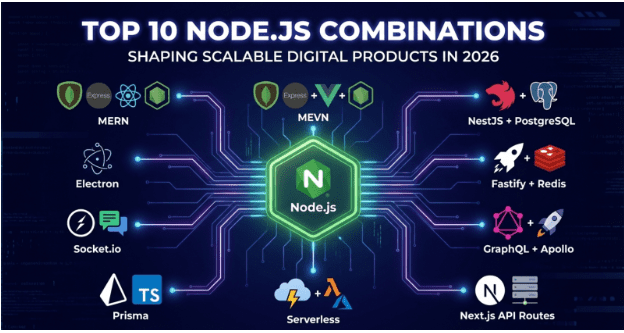
Top 10 Node.js Combinations Shaping 2026
1. MERN (MongoDB, Express, React, Node)
The MERN stack persists not out of habit but because it removes real friction in early-stage product development. JavaScript continuity across frontend and backend means smaller teams can move across layers without context-switching costs.
The trade-off is structure. MongoDB’s flexibility accelerates initial development but can create data modeling problems at scale. Express adds minimal overhead but imposes no conventions, so architectural consistency depends entirely on team discipline. For MVPs, SaaS dashboards, and internal tooling where speed-to-market outweighs structural purity, MERN remains one of the most practical Node.js Combinations available.
2. MEVN (MongoDB, Express, Vue, Node)
MEVN follows the same architectural logic as MERN, with Vue replacing React. Vue’s component model tends to have a lower learning curve for cross-functional teams or developers without a React background. For content-rich SaaS platforms where the frontend team prefers more opinionated structure out of the box, MEVN reduces onboarding friction without sacrificing the full-stack JavaScript advantage.
3. Node + NestJS + PostgreSQL
This combination signals a shift from speed of delivery to structural integrity. NestJS brings dependency injection, modular architecture, and enforced conventions that enterprise teams need to maintain consistency across large codebases and distributed teams.
PostgreSQL adds relational data integrity, mature indexing, and transactional guarantees that fintech, healthcare, and compliance-sensitive environments cannot compromise on.
The honest trade-off: NestJS has a steeper learning curve, and PostgreSQL requires more deliberate schema design than document databases. For teams building systems expected to operate at scale for years, that investment pays back. Among Node.js backend combinations for enterprise-grade platforms, this remains one of the most defensible choices.
4. Node + Fastify + Redis
When performance is the primary constraint, Fastify changes the calculus. Its schema-based request validation and low-overhead architecture consistently outperform Express under high-concurrency conditions.
Redis complements this by absorbing repetitive database load through in-memory caching and enabling real-time response patterns for rate limiting and session management. For high-traffic APIs or performance-sensitive services within a larger platform, this is a precise tool applied precisely.
5. Node + GraphQL + Apollo
GraphQL resolves a specific tension REST APIs create at scale: as the number of frontend clients increases, endpoints either over-fetch or under-fetch, and versioning becomes a management problem. GraphQL gives frontend teams a flexible query layer without requiring backend changes for each new client requirement.
Apollo adds tooling for schema management, caching, and client-side state. The combination works best for multi-surface products serving mobile, web, and third-party integrations from a single API layer. Maintaining a GraphQL schema at scale carries real operational overhead, but for platforms with genuine multi-client complexity, it’s often the right trade.
6. Node + Next.js API Routes
The boundary between frontend and backend has been dissolving for several years, and Next.js API routes represent one of the most pragmatic expressions of that shift. Backend logic, server-side rendering, and frontend code live within a unified framework and deployment model.
For SaaS products that don’t yet need a separate backend service, this significantly reduces infrastructure complexity, no separate pipelines, no separate repositories. The constraint is that it scales to a point. When backend logic grows complex enough to warrant its own service, the migration path is clear.
7. Node + Serverless (AWS Lambda, Azure Functions)
Serverless changes the operational model more than it changes the code. Functions scale automatically, infrastructure management disappears, and cost aligns with usage rather than provisioned capacity.
The practical fit is for event-driven workloads, burst-pattern APIs, and backend-for-frontend services that don’t justify persistent server allocation. Cold start latency is a genuine consideration for latency-sensitive APIs, and vendor lock-in is a real architectural risk. For teams needing operational elasticity without building a platform engineering function, the cost-efficiency trade is usually favorable.
8. Node + Prisma
Prisma has become a default choice for TypeScript-first backends, and the reasoning is direct: auto-generated, type-safe database clients eliminate an entire category of runtime errors that traditional ORMs introduce.
Schema migrations are version-controlled, database access is predictable, and onboarding new developers becomes faster when the data layer is self-documenting. Prisma’s abstraction can occasionally require dropping to raw queries for complex operations, but for the majority of relational data access patterns in SaaS products, it delivers the right balance of ergonomics and reliability.
9. Node + Socket.io
Real-time architecture is not a feature category; it’s a product quality decision. Users now expect live updates, collaborative states, and instant feedback without polling.
Socket.io handles the complexity of WebSocket connections, reconnection logic, and fallback transports so product teams can focus on application behavior rather than protocol management. For chat platforms, collaborative tools, and any interface where latency creates friction, this combination delivers the foundation. Stateful connections do require deliberate session management and horizontal scaling strategies that stateless HTTP services don’t.
10. Node + Electron
Electron extends Node’s reach into cross-platform desktop applications using web technologies. The shared codebase between a web product and its desktop counterpart reduces duplication and keeps feature parity achievable with smaller teams.
The honest limitation is bundle size and memory overhead. For enterprise dashboards, productivity tools, and hybrid products that need both web and desktop presence without building separate native applications, the development efficiency gains outweigh the runtime cost for most use cases.
Node.js Stack Trends in 2026
A few patterns define how serious teams are assembling stacks this year.
TypeScript is no longer optional. Strong typing is now the baseline expectation in any backend system expected to survive its first major refactor.
Serverless adoption continues to expand for edge workloads and event-driven processing, though teams with complex stateful requirements still find managed infrastructure more predictable.
Performance-first API design is influencing framework selection. Fastify and schema validation at the edge are becoming standard rather than late-stage optimizations.
Full-stack consolidation through Next.js reduces operational overhead for products that don’t yet need the separation a dedicated backend service provides.
Structured backend frameworks like NestJS are gaining ground in enterprise environments where consistency, testability, and team scalability matter more than framework flexibility.
Conclusion
Stack selection is a business decision wearing a technical interface. The combination that serves a two-person startup through its first launch looks nothing like the one that sustains a platform through three years of growth, regulatory pressure, and a 10x team expansion.
The right Node.js Combinations are those aligned with your architecture requirements, hiring market, and the operational complexity your team can genuinely absorb. There is no universal answer, but there are poor fits that look reasonable on a comparison chart until the codebase tells a different story.
Engaging an experienced Node.js Development Company gives leadership teams an objective lens on these trade-offs, particularly when internal teams are close to the code and distant from the strategic implications of the choices.
The teams that approach the modern Node.js ecosystem strategically, matching a combination to context rather than defaulting to what’s familiar, are the ones building systems that hold their shape under pressure.