
Share
Share
Share
Share
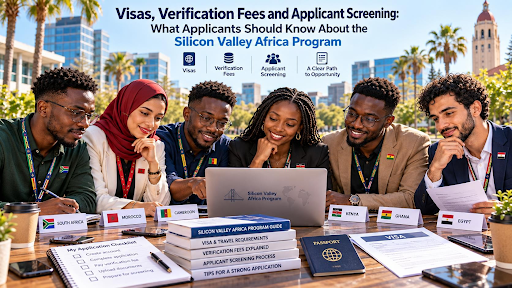
As the U.S.-based initiative recruits candidates across six African countries, questions about verification fees, visa support and applicant screening are drawing attention. Here is what
the program’s published rules say.
Across Africa, the rise of online scams, fake scholarship offers and misleading immigration promises has made skepticism a necessary habit.
So when an international program offers selected African professionals, entrepreneurs and innovators an opportunity to take part in a structured immersion in Silicon Valley, questions are inevitable.
Is the program legitimate? Why are some candidates asked to pay verification fees? Does selection guarantee a U.S. visa? And what happens if a selected candidate is ultimately denied a visa by U.S. consular authorities?
The Silicon Valley Africa Program (SVAP) is operated by First Of All LLC, a U.S.-based company. The initiative says its current edition is open to applicants from six African countries: South Africa, Morocco, Cameroon, Kenya, Ghana and Egypt.
The program has also been announced through a GlobeNewswire release distributed on platforms including Yahoo Finance, while Silicon Valley Weekly has published coverage of the initiative.
A review of SVAP’s published admission rules, terms and visa-support policies provides a clearer picture of how the process is designed to work — and what applicants should understand before moving forward.
Why are candidates asked to pay verification fees?
According to the program’s published rules, submitting an application in Phase 1 is free. No payment is required simply to apply.
Only candidates who are pre-selected and invited to proceed to Phase 2 may be asked to pay a verification fee.
SVAP lists $330 as the full verification amount for non-subsidized categories. However, candidates in the Laureate, Scholar and Delegate tracks pay only a fraction of that amount, with the remainder subsidized by the program.
The amounts paid directly by candidates are:
- Laureate: $20 — approximately 6.1% of the $330 verification amount, meaning about 93.9% is subsidized
- Scholar: $30 — approximately 9.1% paid by the candidate, with about 90.9% subsidized
- Delegate: $30 — approximately 9.1% paid by the candidate, with about 90.9% subsidized
- Business Visitor: $330 — 100% paid by the candidate
- VIP Visitor: $330 — 100% paid by the candidate
In practical terms, a Laureate candidate contributes only about 6 cents for every dollar of the stated verification amount, while nearly 94% is covered by the program.
A Scholar or Delegate pays just over 9 cents per dollar, with roughly 91% subsidized.
By contrast, Business Visitors and VIP Visitors are self-funded and pay the full verification amount.
SVAP says the verification process includes identity checks, document review, criminal-record screening, assessment of the candidate’s profile and administrative processing.
The payment does not amount to purchasing a place in the program. It also does not guarantee final selection.
For scholarship categories, candidates must still successfully complete verification and assessment before the final allocation of available places is determined.
This distinction is central to understanding the process: applicants are contributing toward the cost of verification, not purchasing admission to the United States and not buying a guaranteed place in Silicon Valley.
The program also states that official payments should be made only through its designated platform and that candidates should be cautious about requests for payment through unofficial channels.
Does the Silicon Valley Africa Program guarantee a U.S. visa?
No.
The Silicon Valley Africa Program does not issue visas and cannot guarantee that a candidate will receive one.
Visa decisions remain the sole responsibility of U.S. consular authorities.
SVAP says selected candidates may receive program documentation, invitation material and support in preparing their travel file, but none of those documents can override the final decision of the U.S. Embassy or Consulate handling the visa application.
The program has, however, introduced a risk-sharing mechanism for certain scholarship categories.
Under its published visa-refusal policy, a Laureate whose application has been fully validated by the program but who is subsequently refused a U.S. visa may qualify for a $1,000 project-support grant.
A Scholar in the same situation may qualify for $500.
The payment is not triggered automatically by every visa refusal.
According to the program, the candidate’s file must first have been validated, the refusal must be documented by U.S. consular authorities and the case must pass an internal review.
The support is intended to ensure that a candidate’s project may still receive assistance even if the planned trip to the United States cannot take place.
Business Visitors and Delegates are not included in this mechanism.
How are applicants screened?
SVAP says its admission process combines automated eligibility checks with human review.
At the initial stage, the program checks several basic conditions, including:
- nationality or residence in one of the participating countries;
- compliance with minimum age requirements;
- declaration of a clean criminal record;
- and the number of previous U.S. visa refusals.
Candidates who satisfy those initial requirements may move forward in the process.
At the next stage, the program says applicants are evaluated on broader factors including their motivation, the quality and credibility of their project, the expected impact of the experience and the credibility of their intention to return home after the program.
SVAP also refers to an assessment of non-return risk as part of its internal verification process. That assessment should not be confused with a U.S. government immigration determination.
It is an internal selection procedure used by the program to assess whether an applicant meets its own criteria.
Why is the program limited to six African countries?
For the current edition, SVAP says priority was given to countries whose nationals remain broadly eligible for U.S. B1 and B2 visas.
The six participating countries are:
South Africa, Morocco, Cameroon, Kenya, Ghana and Egypt.
The program says additional countries may be considered in future editions.
This does not mean that candidates from those countries are guaranteed visas or that visa approval is automatic.
Eligibility for the Silicon Valley Africa Program and eligibility for a U.S. visa remain two separate matters.
What does the Silicon Valley itinerary include?
SVAP’s published itinerary describes planned activities across the San Francisco Bay Area and Silicon Valley.
The schedule includes visits or activities associated with major technology and innovation locations, including places linked to Stanford, Google, Apple, Meta, Nvidia, Microsoft, Amazon and Tesla, among others.
These references should be understood as planned itinerary stops or visits listed by the program.
They should not automatically be interpreted as evidence that every company or university mentioned is a sponsor, formal partner or official endorser of the Silicon Valley Africa Program unless such a relationship has been separately confirmed.
That distinction is particularly important for candidates evaluating promotional material.
What is the Delegate program?
SVAP also recruits Delegates in participating countries.
Unlike the main travel-focused categories, the Delegate track is described as a temporary paid representation role.
Delegates are expected to promote the program locally, share accurate information, identify potential candidates, support awareness campaigns and help expand the program’s regional network.
The program states that Delegates receive $200 per month for three months, for a total compensation of $600.
They may also receive certification, access to the program community and priority or guaranteed eligibility for a future Laureate application, subject to the rules of the relevant edition.
The Delegate verification fee is listed at $30, meaning that Delegates pay approximately 9.1% of the standard $330 verification amount, while approximately 90.9% is subsidized by the program.
How can applicants verify the organization independently?
Candidates considering any international program should conduct their own due diligence before paying money or transmitting sensitive documents.
SVAP identifies First Of All LLC as the entity operating the initiative and directs candidates to its official legal and program information.
Applicants can also consult relevant public corporate, business and trademark databases and compare those records with the names and entities appearing on official program documents.
They should also ensure that payments are made only through official channels and retain copies of receipts, emails and program documents.
Questions about money, visas, company registration, data protection or selection procedures should not be viewed as hostility.
For any international program, due diligence is a reasonable and necessary precaution.
What applicants should understand before proceeding
The Silicon Valley Africa Program presents itself as a selective professional and technology-immersion initiative.
It is not a travel agency and does not claim to offer a guaranteed route to immigration. Its published rules draw several important distinctions.
Phase 1 applications are free. Verification fees apply only after pre-selection. Laureates pay about 6.1% of the standard verification amount, while Scholars and Delegates pay about 9.1%, with the remainder subsidized by the program. Business Visitors and VIP Visitors pay the full amount.
Those verification payments do not guarantee admission. Selection into the program does not guarantee a U.S. visa. And final visa decisions remain entirely under the authority of the U.S. government.