
Share
Share
Share
Share
In 2026, a massive database is actually a liability if half the records are ‘ghosts.’ The real winners aren’t those with the most leads, but those with the cleanest, most enriched intelligence.
Many companies still rely on static contact lists filled with outdated emails, inactive phone numbers, and missing operational data. That creates serious GTM problems quickly. Outreach reaches the wrong stakeholders, conversion rates decline, CAC increases, and sales teams waste time validating accounts manually.
Modern revenue teams now expect far more from a database. High-quality B2B databases are built around AI-powered verification, intent signals, technographics data, and continuous enrichment that support faster, more precise GTM execution.
This article explores what separates a high-quality B2B customer database from a basic lead list and why database quality has become a major competitive advantage in 2026.
Why Are Traditional B2B Databases Losing Effectiveness?
Traditional B2B databases were designed around static firmographic filters like company size, industry, or geography. While useful for basic segmentation, they provide very little visibility into how organizations actually operate.
That creates several operational issues:
- Contact records become outdated quickly
- Buying signals are completely missed
- Outreach becomes too broad
- Sales teams spend more time validating accounts
- Territory coverage becomes inconsistent
We’ve all seen the fallout: sales reps wasting half their day playing private investigator because a ‘lead’ hasn’t worked at that company in two years. It’s not just a data problem. It’s a massive drain on morale and your CAC.
In 2026, stale data is not just an inconvenience. It directly impacts conversion efficiency, deliverability, onboarding speed, and customer acquisition costs.
What Data Layers Define a High-Quality B2B Database?
A modern B2B customer database should provide more than basic contact records. It should help GTM teams identify operational fit, buying readiness, and account behavior in real time.
That’s why premium B2B database providers now combine multiple intelligence layers to provide an accurate and verified database, including:
- Firmographic data, such as revenue, industry, geography, and company size
- Technographics data showing technology stacks and vendor ecosystems
- Intent signals that reveal active research and buying behavior
- Verified business emails validated through SMTP checks
- Direct-dial phone numbers that help teams bypass gatekeepers
- Real-time job title and hierarchy updates
- Behavioral engagement insights tied to content consumption and website activity
These layers help revenue teams move beyond broad targeting and prioritize accounts with stronger conversion potential.
Why Does Data Accuracy Matter More Than Database Size?
Many organizations still evaluate databases based on record volume. In reality, poor-quality data creates far more damage than a smaller dataset ever could.
Inaccurate data leads to:
- Higher bounce rates
- Lower conversion rates
- Wasted outreach spend
- Slower sales cycles
- Poor ABM targeting
- Increased manual research time
A smaller database with continuously verified records almost always outperforms a massive static list filled with outdated information.
This is why top-tier B2B database providers now prioritize 90-95% verified contact accuracy rather than maximizing lead volume alone.
How Does AI-Powered Verification Improve Database Quality?
Continuous enrichment has become one of the most important parts of modern database management.
In 2026, leading providers increasingly use AI-powered verification systems to detect outdated records, identify job changes, refresh direct-dial numbers, and validate business emails in real time.
This allows GTM teams to act on fresher intelligence instead of relying on quarterly list updates.
AI-driven enrichment improves:
- Deliverability rates
- ICP accuracy
- Outreach timing
- Segmentation quality
- Pipeline efficiency
Without continuous verification, database quality declines rapidly as records become stale.
Why Are Technographics and Intent Signals So Valuable?
Frankly, knowing who a company is doesn’t cut it anymore. If you’re selling a cloud security tool, you need to know their exact tech stack before you even pick up the phone. Technographics takes the guesswork out of the equation by showing you their digital DNA.
Technographics data helps identify:
- Existing technology environments
- Vendor ecosystem compatibility
- Infrastructure maturity
- Migration or modernization activity
Intent data adds another critical layer by revealing when accounts actively research solutions, compare vendors, or enter evaluation cycles.
Together, these signals support signal-based selling instead of generic mass outreach. This provides the level of competitive market intelligence required to prioritize accounts showing both operational fit and active buying intent.
Why Does Compliance Matter in Modern B2B Databases?
Database quality is not just about enrichment or accuracy. Compliance has become equally important in 2026.
High-quality B2B databases now prioritize GDPR and CCPA-aligned data practices to ensure lawful and ethical handling of customer information.
This often includes:
- Consent and opt-out management
- Secure data storage
- Transparent collection practices
- Verified business-only contact enrichment
- Controlled access across GTM systems
Without strong compliance standards, even highly enriched databases create operational and reputational risk.
How Can Teams Measure Data Decay?
Data decay is one of the biggest hidden problems inside B2B databases.
Teams can measure decay by tracking:
- Email bounce rates
- Disconnected direct-dial numbers
- Job title changes
- Duplicate or inactive records
A simple way to calculate decay is:
Invalid or outdated records ÷ total database records
As organizations evolve, this percentage rises quickly without continuous enrichment.
That is why modern GTM teams increasingly monitor database health as closely as pipeline performance.
How Should a Modern B2B Database Support GTM Teams?
A modern B2B customer database should function as an active GTM intelligence system, not a passive lead repository.
Strong databases now support:
- ABM campaigns
- Territory planning
- Sales prospecting
- Buyer journey personalization
- Pipeline forecasting
- Intent-based outreach
Native integration with platforms like Salesforce, HubSpot, and LinkedIn Sales Navigator has also become critical for operational efficiency.
Without seamless integration, even high-quality data becomes difficult to activate across GTM workflows.
Conclusion
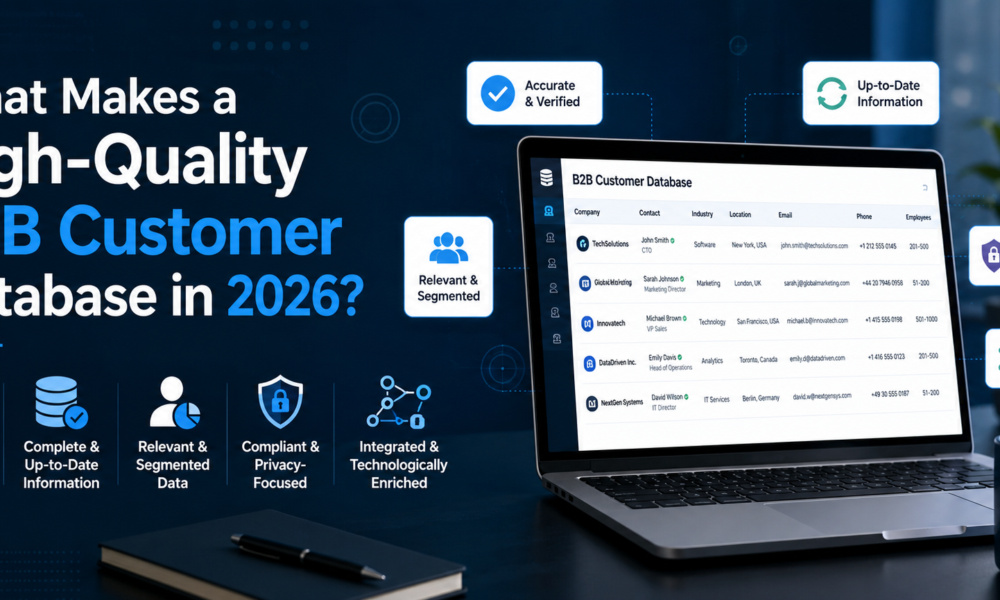
A high-quality B2B customer database in 2026 is defined by accuracy, AI-powered verification, operational visibility, and real-time intelligence, not database size alone.
Organizations relying on static contact lists will continue facing lower conversion rates, higher CAC, and inefficient GTM execution.
The era of ‘spray and pray’ ended years ago, but 2026 is where the gap between data-rich and data-poor teams becomes an ocean. You don’t need more contacts; you need better eyes on the accounts that actually matter. It’s time to stop hoarding data and start activating it.





