
Share
Share
Share
Share
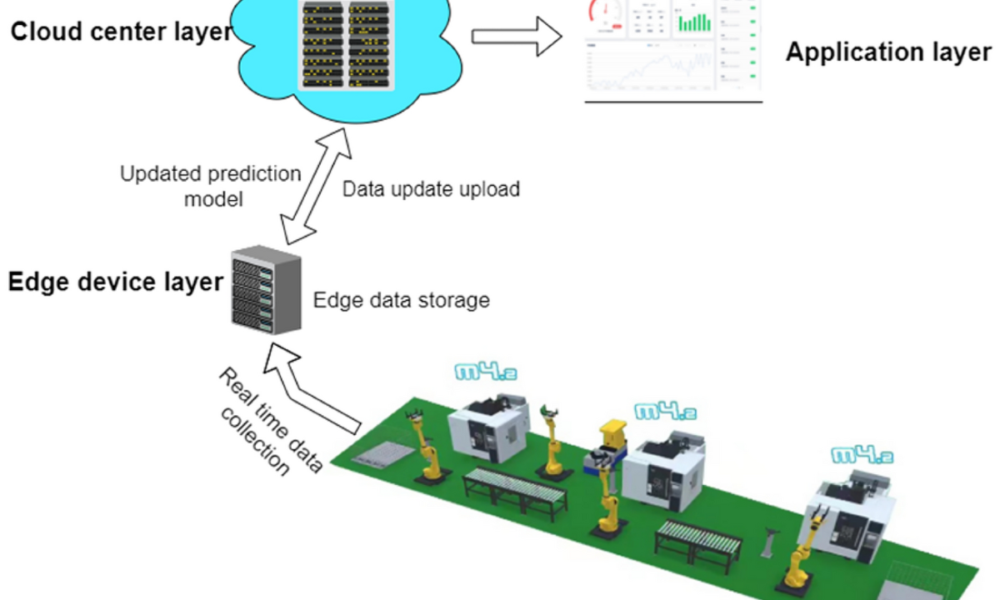
Plant data should live wherever the decision it supports needs to happen. Workloads that are time-critical, safety-related, or required to keep running through a network loss belong at the edge, close to the machines. Workloads that compare sites, need heavy compute, or look back across months of history belong in the cloud. Five questions, applied to each workload one at a time, settle most placement debates in minutes.
Most industrial teams end up with a hybrid design. The hard part is deciding where each individual workload sits, and that decision usually gets made by habit, vendor default, or whoever built the first prototype.
Why the Placement Question Keeps Coming Up
Manufacturers are investing in both directions at once. Deloitte’s 2025 Smart Manufacturing and Operations Survey, which polled 600 executives at large U.S. manufacturers in August and September 2024, found that 57% of manufacturers are using cloud computing at the facility or network level and almost half (46%) are using industrial IoT solutions.
Edge investment is climbing in parallel. An IDC forecast of worldwide edge computing spending puts global spending on edge solutions at nearly $261 billion in 2025, growing at a compound annual rate of 13.8% to reach $380 billion by 2028. IDC identifies Manufacturing and Resources as the second-largest sector, making up a quarter of worldwide spending.
The cost of getting placement wrong depends on the direction of the mistake. Push a time-critical function into the cloud, and the plant inherits a dependency on every router, carrier, and service between the machine and the data center. Keep everything on site, and the organization loses the patterns that only appear when many machines and many sites sit in the same dataset.
With budgets flowing to both layers, the risk is a plant that pays for edge hardware and cloud services without a clear rule for which job goes where. A shared test fixes that.
The Five-Question Placement Test
Most practical frameworks for edge vs cloud analytics for industrial equipment reduce to a handful of questions about timing, resilience, data volume, scope, and access. Each question pushes a workload toward one layer or the other. When the answers disagree, the most safety-relevant answer wins.
1. What happens if the answer arrives late?
Some decisions lose all value after a few hundred milliseconds. NIST’s Guide to Operational Technology Security (SP 800-82 Rev. 3) notes that some systems may require computation to be performed as close to sensors and actuators as possible to reduce communication latency and perform necessary control actions on time. Control loops, interlocks, and fast fault detection pass this test only at the edge.
2. Must it keep running when the network is down?
The same NIST guidance observes that systems with greater impacts often require the ability to continue operations through redundant controls or to operate in a degraded state. If a workload belongs on that list, it cannot depend on a wide-area link. Reporting and fleet-level trend work can usually pause safely; equipment protection cannot.
3. How much raw data does it consume?
High-frequency vibration, current, and pressure signals generate far more data than most connections should carry continuously. An open-access study of an edge-cloud predictive maintenance framework in the journal Sensors ran lightweight anomaly detection on edge devices and sent only flagged events to cloud-hosted deep learning models. The hybrid approach achieved a 35% reduction in latency, a 28% decrease in energy consumption, and a 60% reduction in bandwidth usage compared to cloud-only solutions.
4. Does it need to compare sites or equipment fleets?
Benchmarking one plant against another, or one compressor model against every other unit in the fleet, requires data from many locations in one place. That work belongs in the cloud, where storage and compute scale without new hardware at every site.
5. Who needs to see the result?
Location of the audience matters as much as its role. Results consumed only by operators on the floor can stay local. Results needed by engineers, managers, or specialists at other locations usually need a cloud copy, delivered through a controlled path.
| The tiebreaker rule
When the five questions point in different directions, safety and time-critical control win. A workload that must act on time or survive a network loss belongs at the edge, even if it also feeds cloud analytics. |
Applying the Test: A Sample Placement Map
The table below shows how a typical plant might place common workloads after running each one through the test.
| Workload | Late answer harmful? | Must survive outage? | Placement |
| PID control loops and interlocks | Yes | Yes | Edge |
| High-frequency vibration screening | Yes | Preferably | Edge, with summaries sent to cloud |
| Local alarm handling | Yes | Yes | Edge |
| Failure prediction model training | No | No | Cloud |
| Energy and performance benchmarking across sites | No | No | Cloud |
| Long-term trend analysis and reporting | No | No | Cloud |
Writing the placement map down matters as much as drawing it. A one-page record that lists each workload, its answers to the five questions, and its chosen layer gives new team members, auditors, and integrators a shared reference, and it makes later changes deliberate.
Many workloads split across both layers. A vibration model can score readings at the edge in real time while the cloud retrains it monthly on data from every similar machine. That arrangement keeps fast decisions local and lets the fleet learn as a whole.
Security Shapes the Split Too
Placement decisions are also security decisions. NIST SP 800-82 Rev. 3 states that OT security objectives typically prioritize integrity and availability, followed by confidentiality, while treating safety as an overarching priority. That ordering differs from most IT environments and should inform how data leaves the plant.
A few patterns keep the cloud useful without exposing control systems:
- Send data outward through a segmented network zone instead of connecting cloud services directly to controllers.
- Prefer one-way data flows for analytics workloads that never need to write back to equipment.
- Require explicit, logged permission for any cloud-originated change that reaches a control system.
- Keep local control logic fully functional when every external connection is severed.
Common Mistakes When Drawing the Line
Teams that skip a structured test tend to repeat the same errors:
- Placing everything in the cloud because it is easier to build. This works until the first extended outage stalls a function the plant depends on.
- Placing everything at the edge to avoid security reviews. Sites then lose the cross-site view that reveals repeated failures and wasted energy.
- Ignoring data volume until the bill arrives. Streaming raw high-frequency signals continuously can overwhelm links and storage budgets.
- Deciding once and never revisiting. New sensors, new sites, and new models change the answers, so the placement map needs periodic review.
A Test That Scales With the Plant
The edge and the cloud are complementary layers with different strengths. The edge offers speed, independence from the network, and direct contact with equipment. The cloud offers scale, history, and the ability to compare every site against every other.
Running each workload through the same five questions turns an architecture debate into a repeatable decision. Plants that adopt the test early spend less time redesigning pipelines later, and they keep critical functions running no matter what happens on the other end of the connection.





