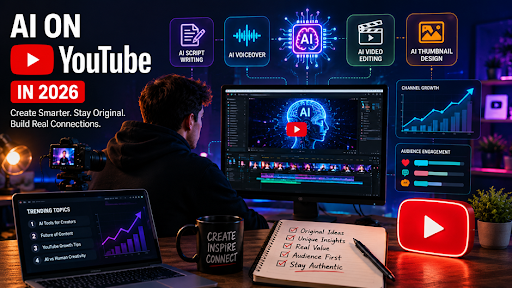
Every marketing team faces the same challenge: the demand for visual content keeps growing, but budgets and timelines rarely keep up. Social media channels need daily posts. Product pages need high-quality imagery. Video has become essential for engagement on every major platform. Yet traditional production — hiring photographers, coordinating shoots, editing footage — remains expensive and slow.
Artificial intelligence is changing that equation. AI-powered image and video generation tools have moved beyond experimental novelty into practical, production-ready territory. For businesses looking to scale their visual content without scaling their costs, these tools represent a meaningful shift in how content gets made.
The Visual Content Bottleneck
Businesses that publish visual content consistently see higher engagement, better conversion rates, and stronger brand recall. But producing that content at the pace modern channels require is a bottleneck for most organizations.
A single product photo shoot can take days to plan, execute, and edit. A 30-second promotional video often requires weeks of production time and thousands of dollars in costs. For small and mid-sized businesses, this creates a painful trade-off: invest heavily in visual content or accept lower engagement across digital channels.
Even larger companies with dedicated creative teams struggle with volume. When every campaign, product launch, and social channel demands unique visuals, the traditional production model simply cannot keep up.
AI Image Generation: Production-Ready Quality at Speed
AI image generation has reached a turning point. Current platforms can produce photorealistic images at resolutions up to 4K, with precise control over lighting, composition, color, and style. Modern AI-generated images meet professional standards in many commercial contexts, from product mockups to marketing campaigns.
For businesses, the practical advantages are significant. Product concept visuals that once required physical prototypes and studio time can be generated from text descriptions in seconds. Marketing teams can iterate on visual campaigns rapidly, testing different styles and compositions without scheduling additional shoots.
Platforms like Nano Banana Pro offer professional-grade image generation with multiple resolution tiers and aspect ratios, making it practical for teams that need production-ready visuals on demand. The ability to go from a text prompt to a polished image in under 20 seconds fundamentally changes the creative workflow.
AI Video Generation: The Next Competitive Edge
While AI image generation has already proven its business value, AI video generation is where the most significant competitive advantages are emerging. Video content often drives higher engagement than static images across social media, email marketing, and landing pages. But it has also traditionally been the most expensive and time-consuming content type to produce.
Recent advances have made it possible to create short-form video content from text prompts or reference images. Tools like the Seedance 2 video generator can produce clips with synchronized audio direction, multiple aspect ratios for different platforms, and consistent subject motion — capabilities that previously required a full production team.
For businesses, this opens up use cases that were previously cost-prohibitive: personalized product videos, social media content at daily publishing frequency, and rapid prototyping of video ad concepts.
Practical Considerations for Adoption
Integrating AI visual tools into a business workflow requires thoughtful planning. Here are the key considerations.
- Quality control remains essential. AI-generated visuals should go through the same brand review process as traditionally produced content. Establishing clear style guides and approval workflows ensures consistency across all outputs.
- Start with internal and low-stakes content. Many businesses find success by first using AI-generated visuals for internal presentations, A/B testing variants, and social media experimentation before scaling to high-stakes customer-facing campaigns.
- Understand the legal landscape. Copyright and usage rights for AI-generated content vary by jurisdiction and platform. Businesses should review the terms of any tool they adopt and consult legal counsel when using AI visuals in regulated commercial contexts.
- Measure and compare. Run AI-generated visuals alongside traditionally produced content and track performance metrics. Let the data guide how much of your visual production shifts to AI tools.
What This Means for Creative Teams
AI visual tools do not replace creative professionals — they amplify them. Designers and content strategists can focus on brand direction, storytelling, and creative strategy while AI handles the volume production that consumes most of their time today.
The businesses that gain the most from these tools are not those that eliminate creative roles, but those that redeploy creative talent toward higher-value work. When a content team can generate dozens of visual variants in the time it previously took to produce a handful, the strategic possibilities expand dramatically.
Conclusion
The visual content demands placed on modern businesses are not going to decrease. AI-powered image and video generation tools offer a practical path to meeting those demands without proportionally increasing costs or timelines. For businesses willing to integrate these tools thoughtfully, the result is not just efficiency — it is the ability to compete visually at a scale that was previously out of reach.