
Share
Share
Share
Share
86% of creators are actively incorporating generative AI in their workflow. In 2026, using AI on YouTube is not what puts your channel at risk. Mass-producing low-effort content with it is. YouTube welcomes AI as a tool and is actively removing channels that use it to flood the platform with templated, repetitive uploads. This guide breaks down exactly what YouTube banned, what still gets monetised, and how to use AI without turning your channel into digital noise.
How AI is Redesigning YouTube Content Creation
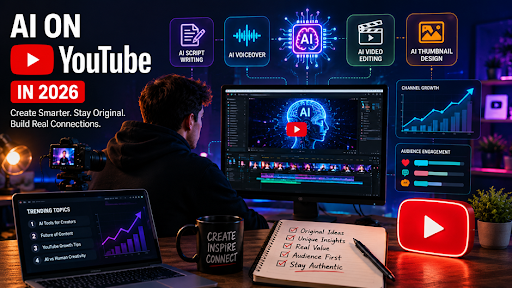
The use of AI on YouTube has increased tremendously in recent years. What began as basic automation has evolved into sophisticated applications capable of creating scripts, voiceovers, hashtags, captions, graphics, and even entire videos.
The scale of the opportunity is why this matters. YouTube generated over $60 billion in revenue in 2025, the first year parent company Alphabet disclosed the platform’s full earnings (Tubefilter). Around 207 million people worldwide now identify as content creators, yet only about 4% earn more than $100,000 a year (according to multiple 2026 industry compilations, including SQ Magazine and Fungies.io). So the audience and the money are enormous, the competition is vast, and almost everyone now has access to the same AI production stack you do.
An overview of the process can look something like this:
| Stage | AI Assistance | Human Input |
| Research | Summarizing sources | Fact-checking |
| Script Draft | First draft | Rewrite in your own voice |
| Editing | Remove pauses and captions | Story pacing |
| Thumbnail ideas | Generate concepts | Final design decisions |
| Analytics | Identify trends | Content strategy |
For example, a creator who makes two educational videos a week can use Notebook LM to summarise their research, ChatGPT to generate a first draft, and Descript to remove filler words. This reduces production time while still maintaining a personal and accurate final script.
It is important to note that while AI can improve productivity, creators remain responsible for the accuracy, originality, and disclosure of AI-generated content. So the real 2026 question is not “should I use AI on YouTube?” It is “how do I use AI without landing in the pile of content that YouTube is actively burying and demonetising?”
Why AI Content Is Becoming Harder to Stand Out
AI tools have made high-quality production accessible to almost everyone. However, as more creators use similar prompts, templates, voiceovers, and editing styles, many videos begin to look and sound alike.
So now, viewers are becoming better at spotting AI-generated videos as many creators use the same prompts, stock footage, AI voices, and repetitive story structures. Channels are increasingly using similar workflows, and production quality is no longer a differentiator. Here’s what the policy says about AI on YouTube in 2026.
- November 2023: YouTube first introduced its AI-generated content disclosure policy.
- May 21, 2025: Mandatory disclosure of realistic, altered or synthetic content went fully live.
- July 15, 2025: YouTube renamed its “repetitious content” policy to the “inauthentic content” policy and raised the bar for monetisation. To earn ad revenue, content must now be “significantly original and authentic.”
Then enforcement got real. In December 2025, YouTube terminated two large channels, Screen Culture (India) and KH Studio (USA), for repeatedly posting AI-generated fake movie trailers. That was the start, not the end. According to industry reports from outlets such as MilX and OutlierKit, a single enforcement wave in January 2026 removed roughly 16 channels with a combined 4.7 billion lifetime views and an estimated $10 million in annual ad revenue.
The important question is not whether to use AI, but how to use AI for YouTube videos without becoming a faceless robot and losing a particular voice and audience engagement.
How to Use AI on YouTube Without Losing Your Monetisation
Nearly 93% of creators utilise AI to produce content more quickly. If your content shows a human fingerprint, AI is not just allowed; it is encouraged. The channels thriving in 2026 share 5 traits, drawn from YouTube’s own policy language and creator-compliance analyses:
Some of the key areas where AI can improve efficiency include:
- Research: Summarise long reports or organise notes, but creators must always verify facts using the source.
- Idea Generation: Propose content ideas, trending topics, and creative angles to assist with a steady publishing schedule. Using the VeeFly AI YouTube Title Generator allows you to instantly discover high-CTR headline variations while keeping your creative energy focused on writing a script.
- Outlining: Create a clear outline of key points to simplify the process of creating clear, engaging videos.
- Editing Support: Support captions, scene selection, trimming, and other editing activities to accelerate production.
- Workflow Automation: Automate repetitive tasks, enabling creators to concentrate more on creativity, strategy, and engagement with the audience.
Note: Creators should continue bringing their own views, experiences, opinions, and narration styles to avoid becoming another addition to AI slop.
How to Make AI-Generated YouTube Videos Stand Out
Even when creators make YouTube videos using AI, the human perspective is often the element viewers remember. Focus on creating unique value, which you may achieve in the following ways:
- Personal Experiences: Share personal knowledge and practical experience that adds authenticity to the content.
- Industry Observations: Highlight trends, developments, and significant changes occurring in your niche or industry.
- Unique Perspectives: Provide unique perspectives that set your content apart from similar videos.
- Case Studies: Show real examples of concepts, strategies, or results.
- Practical Lessons: Offer concrete lessons that viewers can use in their lives.
How to Build a Unique Content Style With AI
As AI-generated videos become more common, consistent branding becomes a competitive advantage. Some elements can help viewers remember your channel beyond a single video. These can include:
- Recurring intro
- Thumbnail style
- Storytelling pattern
- Editing rhythm
- Signature phrases
Remember to vary your formats and thumbnails so your channel never looks bot-assembled. And add a transformative layer to every upload. If you are only feeding prompts and posting whatever comes out, you have no creative fingerprint, and that is exactly the pattern reviewers are trained to flag.
Build Community Instead of Chasing the Algorithm
To build strong audience relationships, you need to interact and engage consistently. Creators can build a deeper connection with their audience by doing the following:
- Respond to Comments: Always respond to comments to encourage interaction and boost engagement.
- Prompt Discussion: Pose questions and solicit opinions to spark meaningful conversations about your content.
- Share Personal Experiences: Include relevant stories, lessons, and insights to make it authentic.
- Understanding Audience Challenges: Identify viewer needs and interests to create more relevant content.
- Using Viewer Feedback: Where possible, incorporate audience suggestions and feedback into future videos.
Making Content Creation More Efficient with AI
One of the best applications of AI for YouTube videos is increasing efficiency without reducing quality. AI can help streamline repetitive tasks, such as:
- Script Writing: AI can generate first drafts that creators can then refine and personalise.
- Video Editing: AI-based editing tools can cut pauses, make captions, and accelerate production.
- Content Research: AI can help creators quickly summarise information, identify trends, and generate topic ideas.
- Performance Analysis: AI tools can analyse audience behaviour and provide insights to inform future content decisions.
Avoid These Five Mistakes Creators Make with AI
While AI can improve efficiency, relying on it too heavily can make content feel repetitive and impersonal. Here’s what creators must avoid:
- Repetitive Scripts: Content is predictable and lacks originality or a unique perspective.
- Robotic Voiceovers: AI-generated narration that sounds devoid of natural tone, emotion, or personality.
- Generic Visuals: Videos have common graphics, stock footage, or templates that don’t stand out.
- Lack of Personality: The content seems impersonal and fails to reflect the creator’s unique voice or style.
- Less Audience Engagement: When content appears too automated or detached from real life, viewers engage less.
Be Open and Honest with Your Audience
As AI-generated content becomes more common, transparency is important to maintain your audience’s trust. Creators are required to disclose when AI generates or significantly alters realistic content that could mislead viewers, such as fake but realistic-appearing people, voices, or events.
Routine editing assistance generally does not require disclosure. Also, Content made with YouTube’s native AI tools, such as Dream Screen and Dream Track, is automatically disclosed, so you do not need to add a label yourself.
The Future of AI for YouTube Videos
AI is expected to become more advanced and accessible in the coming years. Some developments that may shape the future of AI content creation on YouTube include:
- Advanced Video Generation: AI tools can create more sophisticated, realistic video content with minimal manual input.
- Real-Time Editing Assistance: Faster editing capabilities could help creators streamline production workflows.
- Improved Audience Analysis: AI may provide deeper insights into viewer behaviour, preferences, and engagement patterns.
- Personalised Content Recommendations: Enhanced recommendation systems could help creators better target audience interests.
- More Sophisticated Creative Tools: New AI-powered features may support scripting, design, storytelling, and content planning.
Final Thoughts
AI is rapidly becoming accessible to all creators, which means that just using AI tools won’t set your channel apart anymore. The creators who will thrive in 2026 are those who blend the fast pace of AI with their unique ideas, personal stories, and authentic connections with their audience. Think of AI as a helper in your creative process, rather than a substitute for your own creativity.






![How to Create YouTube Videos With AI for Free [5 Tips]](https://techbullion.com/wp-content/uploads/2026/09/Free-AI-YouTube-video-generator-for-creating-videos-from-text-1000x589.png "How to Create YouTube Videos With AI for Free [5 Tips]")