Launching a token presale in 2026 is more technically demanding than it has ever been. Investors are more selective, liquidity is tighter, and the bar for credibility has risen sharply. Still, structured token sales continue to raise significant capital for projects that get the fundamentals right.
So, what separates the raises that hit their targets from the ones that stall? More often than not, the answer is infrastructure. Specifically, whether a project has built the right technical foundation before opening contributions.
This guide covers what a modern token presale actually requires, how token sale smart contracts work, and the most common mistakes founders make before and during a raise.
What Does It Actually Mean to Launch a Token Presale?
A token presale is the fundraising phase that takes place before a token is publicly tradeable. Contributors send capital in exchange for a token allocation at a defined price, typically with a vesting schedule that releases tokens over time after the token generation event (TGE).
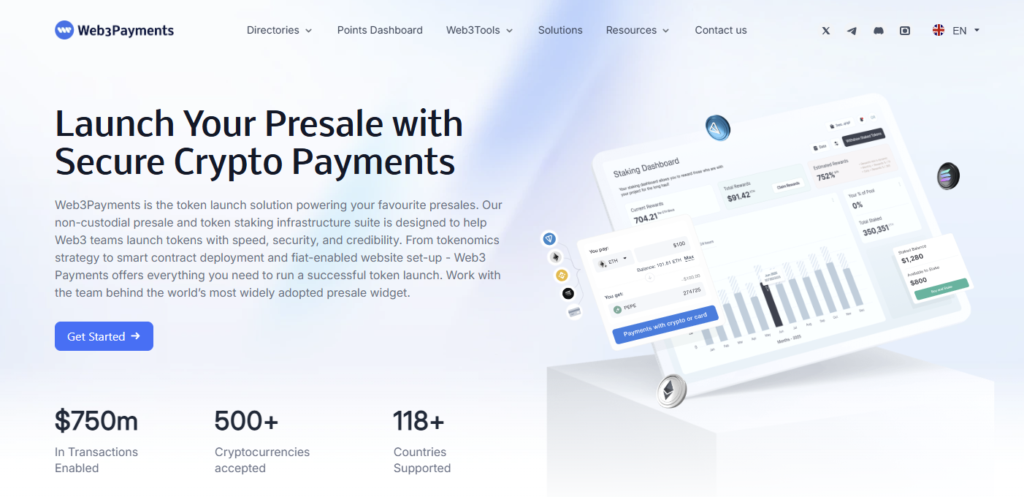
However, running a token presale is not simply a matter of publishing a wallet address and waiting for contributions. A structured token presale includes:
- Token sale smart contracts that handle contribution logic, allocation tracking, and vesting
- Multi-chain payment integration to accept ETH, BNB, stablecoins, and card payments
- A vesting schedule that releases tokens according to your tokenomics design
- A claim interface that allows contributors to access tokens after TGE
- A branded contribution environment, ideally hosted on your own domain
Taken together, these components form what is commonly referred to as token presale infrastructure. Without it, even a strong project will struggle to convert genuine interest into committed capital.
How Token Sale Smart Contracts Work
Token sale smart contracts are the technical backbone of any structured presale. Rather than manually processing contributions and tracking allocations, smart contracts handle this logic automatically and transparently on-chain.
When a contributor sends funds to a presale, the smart contract records the allocation, applies any pricing tier logic, and links the contribution to a vesting schedule. After TGE, contributors interact with a claim contract to receive their tokens according to the schedule.
Importantly, smart contracts are auditable. Buyers can verify the contribution logic and vesting terms before committing funds. This transparency is now a baseline expectation among sophisticated investors in 2026.
Poorly written or unaudited contracts remain a significant risk. Projects that partner with specialist token launch infrastructure providers benefit from factory-deployed, battle-tested contracts rather than one-off code that has not been reviewed under live conditions.
Beyond security, smart contract design also affects conversion. Contribution flows that are slow, unclear, or technically unreliable lose buyers at the critical moment. Infrastructure built and optimised across multiple real raises performs differently from contracts assembled for a single project.
Launchpad vs. Own Token Presale Infrastructure
Many founders default to a launchpad when planning their raise. Launchpads offer distribution and an existing audience, which is genuinely useful at certain stages. Nevertheless, they come with trade-offs that are worth understanding before committing.
Launchpads operate on shared platform frameworks. Pricing tiers, vesting structures, and contribution formats may be constrained by the platform’s standard model. Treasury custody arrangements vary and are not always founder-friendly. Furthermore, your presale runs inside someone else’s marketplace, not your own branded environment.
By contrast, a white label token launch platform gives you full ownership of the presale environment. You define the pricing tiers. You set the vesting schedule. You control the treasury. The sale runs on your domain, under your brand, with your terms.
For a deeper look at how crypto founders are making this shift, this analysis of how new crypto projects are raising millions before exchange listings covers the structural changes driving the move away from shared launchpad models.
What Founders Get Wrong: The Most Common Token Presale Mistakes
Even well-prepared projects make avoidable errors. The following mistakes appear consistently across failed or underperforming raises.
Treating infrastructure as a last-minute detail.
Token presale infrastructure cannot be assembled in the final weeks before launch. Smart contract deployment, allocation configuration, vesting integration, and claim interface setup all require lead time. Projects that start this process too late go live with untested flows and pay the price in conversion.
Launching with weak tokenomics design.
A token price is not a tokenomics model. Investors in 2026 scrutinise circulating supply at TGE, vesting schedules across all allocation categories, staking emission logic, and long-term liquidity planning. A model that cannot withstand these questions will lose the raises that matter most.
Restricting contributions to one chain or asset.
Every unsupported payment method is a drop-off point. Multi-chain payment integration is a baseline expectation. Projects that also accept card payments open their raise to buyers who do not yet hold crypto, a substantial and growing audience.
Underestimating TGE preparation.
Reaching the token generation event underprepared is a common and costly mistake. Liquidity strategy, staking activation, claims infrastructure, and post-launch monitoring all need to be in place before TGE, not assembled after it. Structured token launch support treats TGE preparation as a distinct phase, not an afterthought.
How to Launch a Token Presale: A Practical Checklist
For founders planning a raise in 2026, the following sequence reflects what structured launches actually require.
- Finalise tokenomics design: supply, vesting schedule, staking emissions, and liquidity allocation
- Deploy token sale smart contracts via a secure, audited architecture
- Configure multi-chain payment integration including card payment onramping
- Build a branded presale environment on your own domain
- Prepare staking mechanics ahead of TGE if applicable
- Establish liquidity strategy and claims infrastructure before the token generation event
- Monitor contribution data and wallet behaviour using presale analytics throughout the raise
According to CoinGecko’s 2025 crypto fundraising data, projects with structured presale infrastructure and transparent tokenomics consistently outperform unstructured raises in both total capital raised and post-TGE retention. The operational quality of the raise itself signals project credibility to investors before a single line of product code is reviewed.
Choosing the Right Token Presale Partner
The decision to build token presale infrastructure internally or partner with a specialist provider comes down to timeline, resources, and risk tolerance. Building in-house is possible. However, it requires smart contract expertise, security review, multi-chain integration experience, and front-end development capacity running in parallel.
Most founding teams do not have all of these in place simultaneously. Consequently, partnering with a provider that has deployed infrastructure across multiple live raises reduces both timeline risk and technical risk.
When evaluating options, consider whether you retain full treasury ownership, whether smart contracts are audited, whether the infrastructure supports multi-chain contributions and card payments, and whether TGE preparation is included as part of the engagement.
FAQ
How long does it take to launch a token presale?
With tokenomics design finalised and allocation parameters confirmed, token presale infrastructure can typically be deployed within a few weeks. Preparation and coordination take longer than the technical deployment itself.
Do I need a launchpad to run a crypto presale?
No. A white label token launch platform lets you run a fully branded presale on your own domain, with your own smart contracts and full treasury ownership. Launchpads provide distribution but impose structural constraints that limit what you can do with your raise.
What is a token generation event (TGE)?
A token generation event is when tokens are minted and distributed to contributors. It is typically the point at which exchange listings begin. TGE preparation is a distinct workstream from the presale itself and requires its own planning and execution.
Can I accept card payments in a token presale?
Yes. Card payments integrate through an onramping flow connected to on-chain allocation logic, with no manual reconciliation required. Buyers can participate without holding crypto in advance, which significantly widens the potential contributor base.
What should tokenomics design include before a presale launches?
At minimum: circulating supply at TGE, a full vesting schedule across all allocation categories, staking emission logic, liquidity allocation, and a sustainability model beyond the initial raise. Investors in 2026 expect all of this to be documented and defensible before committing capital.
For informational purposes only. Cryptos carry risk, and their value can rise or fall. Not financial advice