Share
Share
Share
Share
As artificial intelligence continues to flood the internet with endlessly generated content, a fundamental question is emerging across the technology and creative industries: who or what can truly be considered the author?
Bridging Poetry and Code
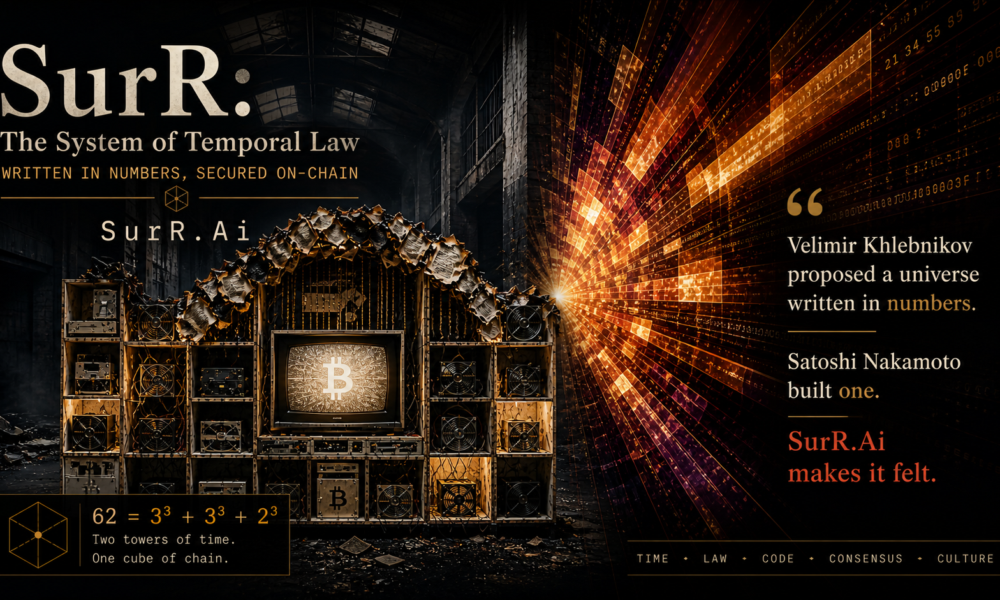
At the core of the project is what Vladi calls an “impossible bridge” between two seemingly unrelated figures: Russian futurist Velimir Khlebnikov and Bitcoin creator Satoshi Nakamoto.
Khlebnikov sought to uncover the mathematical patterns governing history, while Nakamoto created a system that permanently records events through blockchain. According to Vladi, both were ultimately working toward the same idea: that numbers are the only universal language capable of preserving truth.
This connection becomes especially relevant in today’s AI landscape, where content can be generated infinitely but rarely carries verifiable intent. By linking poetic philosophy with cryptographic systems, SurR.Ai attempts to anchor creativity within a provable structure.
From the Cloud to the Clock
One of the central concepts behind The System of Temporal Law is the transformation of digital art into what Vladi calls an “an irreversible digital object grounded in the physical world.”
Most AI-generated works exist as editable, deletable files stored in the cloud. In contrast, SurR.Ai embeds its work into blockchain-based systems, where each piece is permanently timestamped. This process moves art from what Vladi describes as “the Cloud,” a space of convenience and storage, to “the Clock,” where events are recorded as fixed moments in time.
The distinction is critical. In a cloud-based system, content is fluid and disposable. In a time-based system, it becomes historical fact anchored to reality.
By anchoring a work to a specific moment, authorship is no longer just about who created something, but when that creation was finalized and verified.
Rethinking Authorship in AI
SurR.Ai’s approach challenges the dominant paradigm of AI creativity, where prompting is often equated with authorship. Vladi draws a clear distinction: prompting is a request, while authorship comes from direction.
Instead of generating outputs through isolated prompts, his methodology involves constructing a system, complete with mathematical constraints, temporal frameworks, and conceptual architecture, within which AI operates.
He compares the difference to that of a search query versus a choreographed performance. The AI may execute the movement, but the human defines the structure, rhythm, and meaning.
This shift positions the artist not as a generator of images, but as a designer of systems. A role that may define the future of creative work.
Numeric Humanism and the Role of Structure
Central to this philosophy is the concept of “Numeric Humanism,” the idea that human authorship can be preserved through mathematical rigor. In The System of Temporal Law, this principle is embodied in a strict structural framework. The piece runs for exactly 62 seconds, derived from the equation: 62 = 3³ + 3³ + 2³
This numerical architecture is not arbitrary. It functions as a signature, proof of deliberate human design within an otherwise generative system. In this context, mathematics becomes more than a tool. It becomes a form of authorship.
From Infinite Content to Verified Meaning
While much of today’s AI ecosystem prioritizes speed, scale, and output, SurR.Ai takes the opposite approach, focusing on permanence and verification.
Vladi argues that most AI-generated content is “statistically likely but spiritually empty,” lacking the structural intent and human direction necessary to carry lasting cultural meaning. In an environment increasingly saturated with infinite machine-generated variation, he believes the truly scarce asset will be verification where the ability to prove that a work is authentic, intentional, human-directed, and permanently fixed within time.
In this model, authorship is no longer defined by output alone, but by the ability to anchor intention into a verifiable moment in history.
This philosophy is reflected in the visual progression of the work itself, which moves from fragmented imagery to structured coherence, mirroring how blockchain systems resolve uncertainty into consensus.
The piece is designed as an audiovisual system, where each moment builds toward confirmation, translating abstract inputs into a mathematically resolved output. In this sense, the work is not just viewed but verified.
To fully grasp this transition from poetic generation to cryptographic permanence, the project is intended to be experienced alongside its visual form, an integrated system where art, time, and proof converge.
A New Era of Creative Systems
Rather than positioning SurR.Ai as a standalone art project, Vladi frames it as part of a broader evolution. One that merges artificial intelligence, blockchain, and the historical concept of “Total Art.” By adding a layer of permanent verification to immersive, system-driven creation, SurR.Ai aims to establish a new category of cultural production: one where art is not just experienced but recorded as part of an immutable timeline.
Looking ahead, Vladi envisions a future where creativity is defined less by individual outputs and more by the systems that produce them. In this model, the artist becomes an architect of meaning, designing frameworks that guide AI while preserving human intent.
As AI continues to reshape the boundaries of authorship, The System of Temporal Law offers a compelling alternative: a world where creativity is no longer lost in the infinite scroll, but anchored, mathematically and permanently, into history.