Share
Share
Share
Share
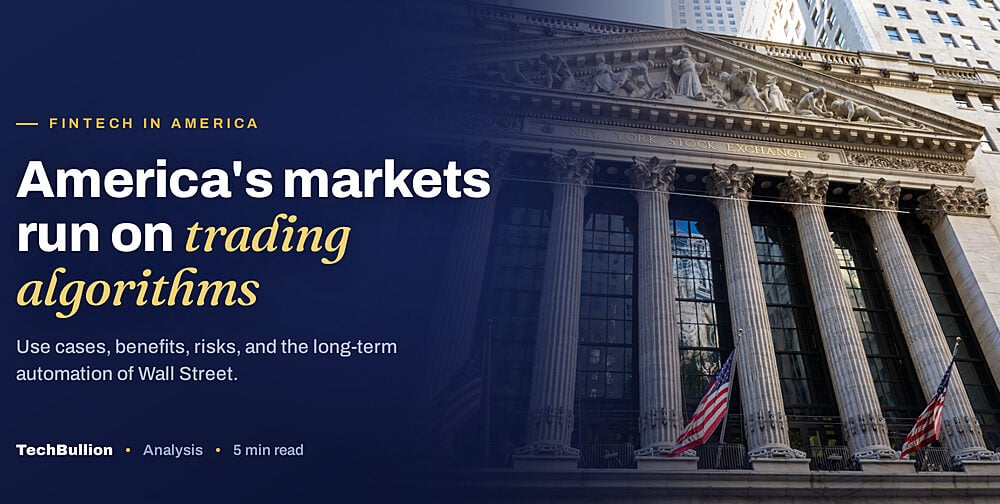
Index funds, pension plans, and the brokerage app on a commuter’s phone now share a common engine: code that decides when and where to buy. Algorithmic trading in America has moved from the trading floors of a few Wall Street firms to the back end of mainstream finance. North America generated 38.14% of global algorithmic trading revenue in 2025, the largest share of any region, and the worldwide market reached $20.23 billion in 2026 on its way to $29.54 billion by 2031, according to Mordor Intelligence.
How America’s markets became automated
The shift did not happen overnight. When United States exchanges moved from fractional pricing to pennies in 2001, spreads collapsed and manual market making became less profitable, which opened the door to electronic firms. The Securities and Exchange Commission’s Regulation National Market System, adopted in 2005, then required brokers to route orders to whichever venue showed the best price. That rule fragmented trading across more than a dozen exchanges and dozens of alternative trading systems, and only software could track prices everywhere at once. By the 2010s automated systems handled the majority of United States share volume, a position they have held since. That history explains why the market looks the way it does today, with liquidity spread thin across many venues and stitched together by routing code.
Where algorithmic trading shows up in America
The most visible use case is market making. Firms post continuous buy and sell quotes and earn the spread, and six principals, Citadel Securities, Virtu Financial, Jump Trading, XTX Markets, Tower Research Capital, and Hudson River Trading, supply an estimated 30% to 40% of displayed depth on major venues. A second use case is execution for asset managers, who hand large orders to algorithms that work them quietly across the day. A third is index rebalancing, where funds tracking the S&P 500 must trade specific names on a schedule, creating predictable flows that specialist programs handle. Exchange-traded funds add a fourth use case: authorized participants run automated baskets to create and redeem ETF shares, keeping fund prices in line with the underlying holdings. The same logic reaches retail through robo-advisors and automated rebalancing, where a consumer app trades on a schedule without anyone placing each order by hand.
The benefits that pushed adoption
Cost is the first benefit. Automated execution narrows the spread an investor pays and reduces the market impact of large trades. Capacity is the second. A single desk can watch thousands of instruments at once, something no human team can match, and every order leaves a timestamped record that makes after-the-fact review far easier than the paper tickets of earlier decades. Discipline is the third. A program follows its rules without the hesitation or overconfidence that hurts manual traders. These advantages explain why institutional investors accounted for 61.16% of the market in 2025 and why the retail segment is growing at an 8.32% annual rate through 2031.
The mechanics behind these gains, order slicing and smart routing, are covered in our guide on how algorithmic trading works. The short version is that software breaks a big order into many small ones and sends each piece to the venue offering the best price at that moment.
The risks regulators watch
Speed cuts both ways. When volatility jumps, many algorithms pull their quotes together, draining liquidity and amplifying price swings. United States exchanges counter this with circuit breakers that pause trading when prices move too fast. A second concern is manipulation. Regulators have fined firms for spoofing, the practice of posting orders with no intent to fill them in order to mislead other traders. A third is concentration. When a handful of firms provide most of the liquidity, an outage at one of them can ripple across the market, since other participants depend on those quotes to price their own orders. This is part of why high-frequency trading draws sustained regulatory attention. There is also a retail dimension. As more individuals run automated strategies they license rather than understand, the chance of a poorly tested program causing losses rises, which is why brokers now cap message rates and require risk checks before an algorithm can go live.
Long-term opportunities for algorithmic trading in America
The next phase favors firms that fold machine learning into execution rather than chase raw speed alone. Cloud deployment already captured 54.47% of spending in 2025, which lets smaller teams run the kind of back-testing that once required a server room. Methods such as reinforcement learning for trading are being tested to adapt strategies as conditions change. Tokenized assets and crypto venues add new instruments for automated strategies to trade, widening the field beyond stocks and futures. Regulators are also pushing best-execution reporting to finer detail, which rewards vendors that build compliance directly into their execution code rather than bolt it on afterward.
Retail is the other frontier. Zero-commission brokers now ship scripting tools and strategy marketplaces that let individuals license proven code instead of writing it from scratch. As trading education improves and application programming interface limits loosen, more of that automated volume will come from outside the traditional institutions, gradually broadening who participates in the market rather than just how fast they trade.
Benefits and risks at a glance
| Dimension | What it means | Evidence |
|---|---|---|
| Liquidity | A few firms supply most visible depth | 30% to 40% from six principals |
| Regional weight | North America leads global spending | 38.14% share, 2025 |
| Retail growth | Individuals automate more trades | 8.32% CAGR to 2031 |
| Concentration risk | Outage at one maker hits the market | Circuit breakers in place |
Algorithmic trading in America is no longer a niche of the fastest firms. It is the default plumbing of public markets, reaching from pension funds to phone apps, and its footprint keeps widening as cloud tools lower the cost of entry. The open question is governance: whether surveillance and circuit breakers can keep pace with strategies that learn and adapt on their own. For the underlying strategy definitions, the reference entry on algorithmic trading is a useful starting point.