Share
Share
Share
Share
A decade ago, opening a savings account meant a trip to a branch and a rate that barely moved. Today a worker can split a $90 pair of shoes into four payments at checkout, earn a competitive yield from an app on the bus home, and let software rebalance a retirement portfolio overnight, all without speaking to anyone. That shift is what financial product innovation means in practice, the steady reinvention of how money is borrowed, saved, paid, and invested. The United States fintech market, valued at about $66.82 billion in 2026 and forecast to reach roughly $135.42 billion by 2031 according to Mordor Intelligence’s US fintech market report, is largely a story of new products built on old money.
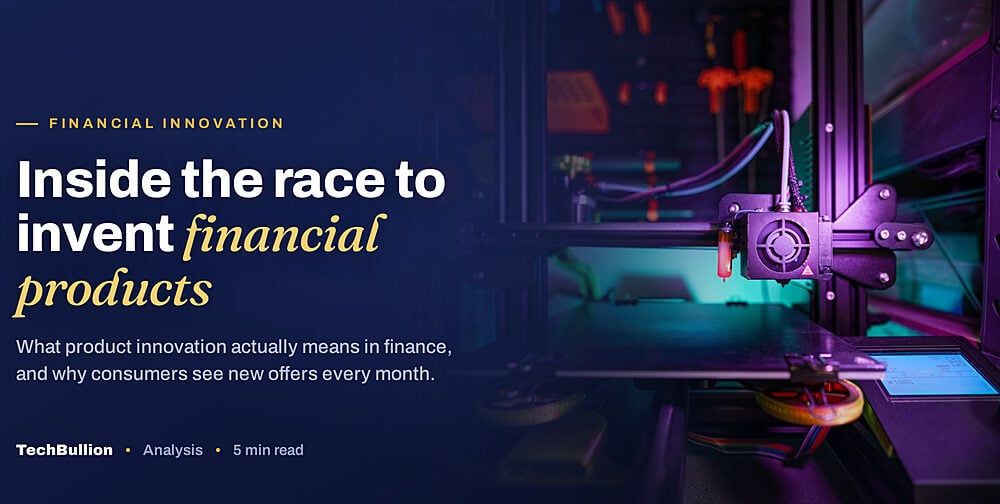
This article explains what financial product innovation is, what is driving it, and what it means for the consumers who use these products and the businesses that build them.
What financial product innovation actually means
Financial product innovation is the creation of new ways to deliver a financial service, often by repackaging an old one to be faster, cheaper, or available where it was not before. Buy now, pay later turned installment credit into a checkout button. Embedded finance put a bank account inside a retail or software app. Robo-advisers turned portfolio management, once reserved for wealthy clients, into a low-fee service anyone can open with a few dollars. High-yield digital savings accounts pushed rates that legacy branches rarely matched.
None of these products required inventing money. They required new rails, cheap computing, and open connections between systems, the same forces driving companies described in this look at why AI-native companies will outpace digital-first ones.
What is driving the wave
Three forces sit behind the surge. The first is infrastructure. Instant payment rails and the Federal Reserve’s FedNow Service, launched in July 2023 and now connecting more than 1,400 institutions according to its two-year service update, let new products move money in seconds. The second is data and APIs, the connectors that let a non-bank app offer a bank-grade service, which is the foundation of open banking and the open banking experiments now spreading. The third is competition. As more providers enter, they compete on product, not just price, which pushes everyone to ship features faster than a traditional bank release cycle ever allowed. A neobank can test a new savings feature with a slice of users in a week, learn from it, and roll it out, a pace that reshapes customer expectations across the whole market.
The result is visible in the numbers. Neobanking is growing at roughly 21 percent a year in the US, the fastest of the major fintech segments, per Mordor Intelligence, while digital payments already account for close to half of the market.
What it means for consumers
For consumers, the benefit is more choice and usually lower cost. A saver can earn a real return without a minimum balance. A shopper can spread a purchase without a credit card. A first-time investor can start with spare change. The risk is that frictionless products can also make it easier to overextend, because a payment split into four feels smaller than it is, and instant credit can hide its true cost. A product that removes every speed bump also removes the pause that once made a person reconsider a purchase. The same speed that helps a careful user can hurt an unwary one.
Transparency is the dividing line. The best new products make the cost obvious, showing the total a shopper will pay or the fee a saver gives up. The worst bury it in fine print and lean on the convenience to keep people from looking. Regulators have started to treat some of these products, buy now pay later in particular, more like the credit they resemble, which over time should push disclosure toward the clearer end.
Innovation by product type
The table below groups recent financial product innovations by what they reinvented.
| Product | What it reinvented | Who it reaches |
|---|---|---|
| Buy now, pay later | Installment credit at checkout | Shoppers without credit cards |
| Embedded finance | Banking inside non-bank apps | Software and retail customers |
| Robo-advisers | Low-fee portfolio management | Small and first-time investors |
| High-yield digital savings | Competitive rates without branches | Everyday savers |
Sources: Mordor Intelligence US fintech market report; Fortune Business Insights fintech market report, which values the global fintech market at $394.88 billion in 2025, growing to $1.13 trillion by 2032 at a 16.2 percent compound annual rate.
Where the next products will come from
The richest ground for new products is the gap between what data now makes possible and what legacy systems still do by hand. Cash-flow underwriting is one example. Instead of relying only on a credit score, a lender can read the real-time inflows and outflows of a small business and extend credit to a firm a traditional model would reject. Programmable payments are another, where money carries rules, such as funds that release only when a delivery is confirmed. Each of these turns a richer data stream into a product that did not exist a few years ago.
Personalization is the quieter frontier. The same engines that recommend a film can tune a savings plan, flag a subscription a household forgot, or move idle cash into a higher yield automatically. The line between a financial app and a financial adviser is thinning, and the products that sit on that line are some of the fastest growing in the market.
What it means for businesses
For businesses, financial product innovation is both an opportunity and a threat. A software company can add payments or lending and turn a one-time sale into recurring revenue, which is the core promise of embedded finance and of building money movement into operations, as shown in this look at ERP-centric payments and treasury. The threat is that a nimble entrant can unbundle a profitable product a bank assumed was safe. Compliance is the constant tax on all of it, which is why regtech and payment innovation tend to grow together.
The next round of products will lean on richer data and instant settlement to do things a card and a paper statement never could. The firms that win will be the ones that make the new power obvious and easy to trust, not just easy to use.