Share
Share
Share
Share
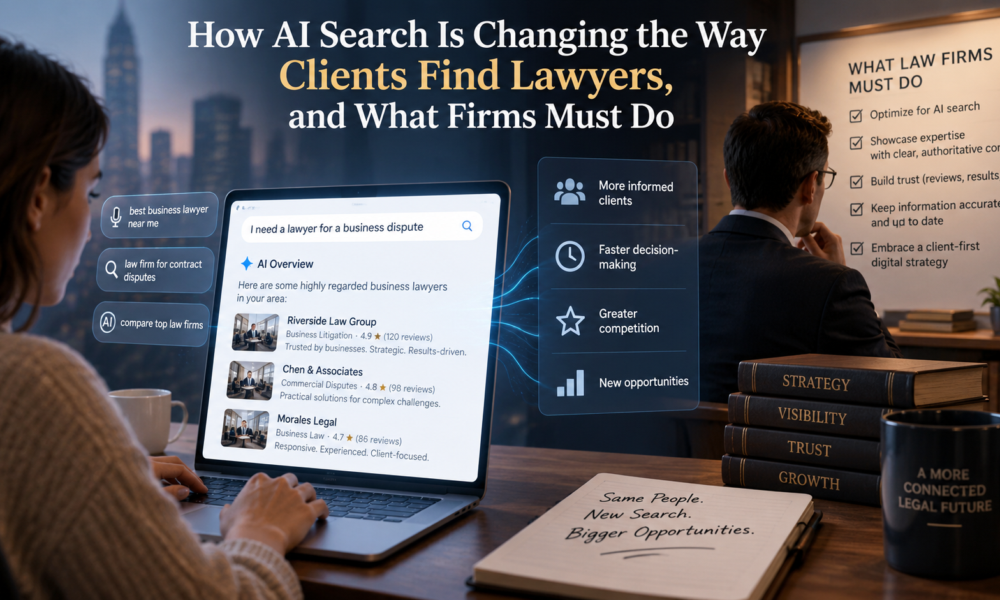
For two decades, the way people found a lawyer online followed a predictable script: type a query into Google, scan a page of blue links and a map, click a few, and call. That script is now being rewritten in real time. A growing share of people looking for legal help are no longer starting with a list of links – they’re asking an AI. They open ChatGPT, Gemini, Perplexity, or Google’s own AI Overviews and ask, in plain language, “what kind of lawyer do I need for a landlord dispute?” or “find me a good personal injury attorney in my area.” The answer they get shapes who they contact.
This is the most significant shift in legal client acquisition since the arrival of search itself, and it’s forcing law firms to rethink how they become discoverable. For firms trying to understand what the change requires in practice, resources that break down modern legal search strategy – you can view page for a detailed treatment – have become essential reading, because the old playbook is quietly losing its power.
The scale of the shift
This isn’t a fringe behavior confined to early adopters. The adoption curve has been startlingly steep.
According to BrightLocal’s local search research, the share of consumers using ChatGPT or AI tools to get local business recommendations jumped to roughly 45% in 2026, up from just 6% at the start of 2025 – a sevenfold increase in about a year. In the legal context specifically, Clio’s Legal Trends Report found that 28% of consumers were directed by an AI tool to contact a lawyer. People aren’t just using AI to understand their legal problem; they’re using it to decide who to hire. Industry analysts have gone further, with some predicting that traditional search engine volume could decline meaningfully over the next few years as AI answer engines absorb a growing share of queries.
For a law firm, the implication is direct: if your firm isn’t visible to the AI systems that are increasingly mediating the search for legal help, you’re becoming invisible to a fast-growing segment of prospective clients – regardless of how well you rank in traditional results.
From ranking to being cited
The core change AI search introduces is a shift in the goal itself. Traditional SEO aimed to rank your website at the top of a results page. AI search aims for something different: to have your firm cited, recommended, or summarized as the answer when someone asks an AI for legal help.
This has given rise to what practitioners call generative engine optimization (GEO) – optimizing not just for how search engines crawl and rank pages, but for how AI models retrieve, interpret, and summarize information about your firm. As TechBullion has explored in its analysis of how AI search is changing website strategy for law firms, the firms that win in this environment are the ones publishing the clearest, most useful, most trustworthy content – because that’s what AI systems draw on when they assemble an answer.
The mechanics differ from classic SEO. AI models favor content that is well-structured, factually reliable, and clearly attributed to a credible source. Entity authority – how clearly and consistently the web establishes who your firm is, what it does, and where it operates – matters more than any single page. Structured data, consistent firm information across the web, and genuine subject-matter authority are the raw materials AI uses to decide whether your firm deserves to be the answer.
The fundamentals matter more, not less
A common misconception is that AI search makes traditional SEO obsolete. The opposite is closer to the truth: it makes the fundamentals more important, not less.
AI systems don’t invent their recommendations from nothing. They draw on the same signals that have always underpinned good local SEO – an accurate and complete Google Business Profile, consistent contact information, strong reviews, local relevance, and authoritative content. As TechBullion notes in its examination of AI, search intent, and the new digital front door for law firms, if a firm’s local signals are inconsistent or underdeveloped, it will struggle to appear credible in both traditional and AI-assisted discovery. AI search doesn’t replace the foundation; it reads from it. A firm with weak fundamentals doesn’t just rank poorly in Google – it becomes uncitable by the AI that increasingly stands between clients and their choice of lawyer.
What firms must do now
The transition is early enough that firms acting now can build a durable advantage before the field catches up. The practical priorities:
- Strengthen the fundamentals first. A complete, accurate, actively maintained Google Business Profile, consistent information everywhere, and a robust review program remain the foundation for both traditional and AI discovery.
- Publish genuinely authoritative content. AI rewards clarity, usefulness, and trustworthiness. Content that thoroughly and honestly answers the real questions prospective clients ask is what AI systems cite – and it can’t be faked with volume.
- Build entity clarity. Make it unmistakable across the web who your firm is, what it practices, and where it operates. Consistency and structured information help AI understand and trust your firm.
- Avoid the shortcuts. The temptation to flood a site with AI-generated filler will backfire. AI answer engines are increasingly good at distinguishing genuine authority from manufactured content, and trust – always the currency of legal marketing – matters more than ever.
- Monitor your AI visibility. Just as firms once tracked keyword rankings, they now need to track how they appear in AI answers, and adjust accordingly.
The bottom line
The way clients find lawyers is being reinvented, and the reinvention favors firms that adapt early. The shift from ranking to being recommended, from keywords to authority, from links to citations, rewards exactly the qualities that have always defined a trustworthy firm – clarity, credibility, and genuine expertise – now expressed in a form that AI systems can read and relay.
For law firms, the message is neither panic nor complacency. AI search is a genuine disruption, but it builds on fundamentals rather than discarding them. The firms that invest now in strong content, clean data, and real authority won’t just survive the transition – they’ll be the ones the AI recommends while their competitors are still wondering why the phone stopped ringing.