Share
Share
Share
Share
Furniture buyers in 2026 want two things that used to be in tension: full customization and fast, predictable delivery. A cabinet shop or millwork factory that can only offer one of those is competing on price alone. The shops pulling ahead are the ones that have re-engineered their cutting and finishing floor around CNC routing as a system, not a single machine.
This article looks at what actually changes on the production floor when a shop moves from manual or entry-level routing to a properly integrated CNC line — and where the real payback shows up.
The Real Bottleneck Isn’t the Design File, It’s the Floor
Most furniture defects and delays don’t originate in the design software. They originate at the point where a digital panel design meets a physical sheet of material: inconsistent nesting layouts, tool paths that don’t account for grain or panel warp, and a finishing step that was never calibrated against the router that feeds it.
A shop cutting a handful of panels a day can absorb this with skilled labor and patience. A shop trying to run mixed SKUs at volume cannot. The gap between “the CAD file says this fits” and “the physical part fits” is where margin disappears — in rework hours, in scrapped board, and in missed ship dates.
Nesting Software: Where the Waste Actually Gets Cut
Before a single tool touches material, nesting software decides how much of that sheet becomes finished product versus offcut. This is arguably the single highest-leverage decision in the entire process, because board cost is often the largest line item in a cut list.
Two things separate a well-run nesting setup from a mediocre one:
- True automatic nesting that accounts for grain direction, remnant tracking, and common-line cutting, rather than a human laying out parts by eye.
- Software that talks to the machine’s controller directly, so the optimized layout becomes a G-code job without manual re-entry — removing a step where errors creep in.
Because the differences between nesting packages are not always obvious from a spec sheet, a side-by-side comparison of the current options is genuinely useful reading for anyone specifying a new line; ours is at nesting-cnc-software-comparison.
Where 5-Axis and ATC Capability Actually Pays Off
Standard 3-axis routing handles flat-panel case goods well. The complications start with curved fronts, angled joinery, mixed drilling patterns across a batch, and profile work that would otherwise require a second station or a manual tool change mid-job.
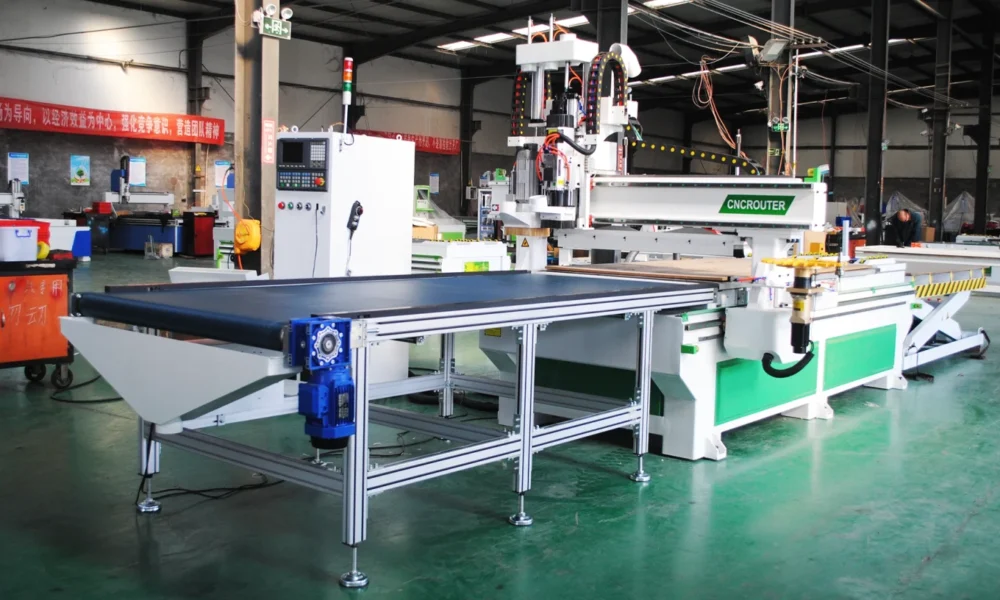
An automatic tool changer (ATC) removes the manual swap; a 5-axis head removes the need to reposition the part for angled cuts. Purpose-built wood and furniture CNC routers built around ATC and multi-axis heads are engineered specifically for this — running drilling, grooving, and profile-cutting operations back to back without operator intervention between them. Whether the added axis or the tool changer is worth the capital cost depends heavily on a shop’s actual product mix; a shop running 90% flat panels gets a smaller return from 5-axis capability than one producing curved fronts or sculptural elements regularly.
Finishing Is Where Router Precision Either Pays Off or Gets Wasted
Cutting a panel to tolerance means little if the edge-finishing step downstream isn’t calibrated to match it. This is one of the more common — and more avoidable — failure points in furniture production: a router holding good tolerance feeds an edge bander running the wrong glue temperature or pressure setting, and the resulting tape lift or glue line gets blamed on “the CNC” when the actual fault is downstream.
The practical fix is treating router output tolerance and bander input calibration as one connected specification, not two separate departments. For teams working through recurring banding defects, a structured troubleshooting reference — such as our edge banding machine troubleshooting guide — tends to isolate the actual cause (pre-milling depth, roller pressure, glue pot temperature drift) far faster than adjusting settings by trial and error.
A Practical Framework for Comparing Routing Approaches
| Approach | Fit/Edge Consistency | Typical Panel Waste | Labor per Batch | Best Fit |
|---|---|---|---|---|
| Manual routing / hand tools | Operator-dependent | High | High | Very low volume, one-off pieces |
| Entry-level 3-axis CNC + basic nesting | Repeatable | Moderate | Moderate | Small shops, standard panel work |
| ATC/5-axis router + automated nesting + calibrated finishing | Consistent, tight tolerance | Low | Low | Mixed SKUs, mid-to-high volume, tight lead times |
The practical question for most shops isn’t whether to automate — it’s which stage of this table their current order mix actually justifies. Adding a single well-specified nesting router is usually the highest-return first move; connecting it properly to a calibrated finishing line is the second.
Where This Fits Into a Broader Sourcing Decision
CNC hardware is a long-duration capital purchase, typically running for a decade or more on a working floor, so the manufacturer’s engineering documentation and after-sales support matter as much as the initial spec sheet. Manufacturers such as YIHAICNC, based in Jinan, China, publish this level of maintenance and troubleshooting detail publicly precisely because routers and edge banders that are well-documented and well-maintained are the ones that actually deliver on their rated tolerance over years of production — not just on the day they’re installed.
For manufacturers evaluating a new or expanded line, the full CNC machine catalog covers the range from entry 3-axis routers to ATC and 5-axis systems built for panel furniture, cabinet doors, and mixed-material production.
Frequently Asked Questions
Q: Is 5-axis capability worth it for standard flat-panel cabinet work? A: Usually not on its own. A well-configured 3-axis ATC router with good nesting software covers flat-panel case goods efficiently. Five-axis capability earns its cost when curved fronts, angled joinery, or sculptural components are a regular part of the product mix, not an occasional exception.
Q: What’s the most common cause of edge banding defects on CNC-cut panels? A: A mismatch between the router’s actual panel tolerance and the bander’s feed, pressure, or glue-temperature settings — not the router itself. Recalibrating the two stages together, rather than treating them as independent, resolves most recurring defects.
Q: How much of a factory’s material cost does nesting software actually affect? A: It varies by product mix and sheet material, but because board cost is frequently the largest single line item in a cut list, even modest improvements in nesting efficiency tend to have an outsized effect on margin compared with other production changes.
Q: Should a shop upgrade its existing router or replace it when adding automation? A: It depends on the age and condition of the spindle, controller, and rail system. In many cases a controller or tool-changer upgrade extends a machine’s useful life at a fraction of replacement cost; a full replacement makes more sense when the base machine’s rigidity or spindle power is the actual limiting factor.