Every forecast your team made last year had one thing in common: they all anticipated that tomorrow would resemble yesterday. For most of history, that assumption held. It doesn’t anymore.
Markets shift mid-quarter. Supply chains crack without warning. A regulatory change in one region can reshape markets elsewhere before businesses have time to react.
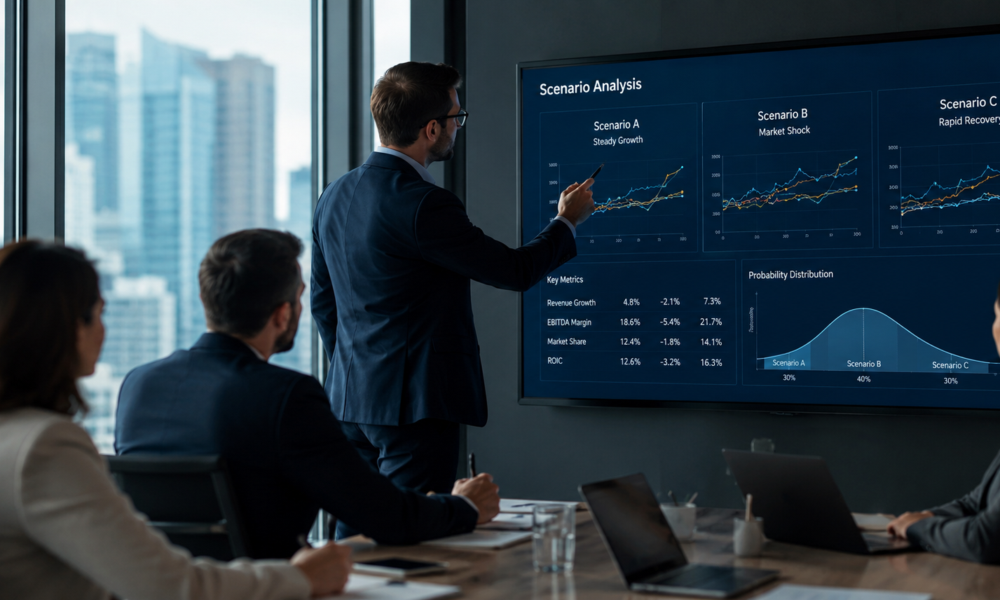
This is the problem scenario analytics is built to solve. It doesn’t ask what will happen. It asks what could happen across a range of plausible futures and what your business should do in each one. That’s a fundamentally different kind of planning. And right now, it’s becoming the difference between enterprises that lead and those that scramble.
How Does Scenario Analytics Create Smarter Strategic Decisions?
PwC’s May 2025 Pulse Survey found that 57% of executives admitted to missing opportunities simply because decisions took too long. This goes on to show that in volatile markets, slow is the new wrong.
This is exactly where scenario analytics earns its place. Instead of placing a wager on a single forecast or waiting for circumstances to change, companies may stress-test several futures and approach each significant choice with preparedness. Let’s take a closer look:
- It Replaces Single-Point Forecasts with a Range of Plausible Futures: Traditional forecasting produces one answer. Scenario analytics produces several, each grounded in a different set of assumptions about how key variables will move. Instead of staking the entire plan on a single result, leaders begin developing methods that work in a variety of scenarios that might actually occur in the future.
- It Identifies the Variables That Actually Drive Business Outcomes: Not every variable merits modeling. Finding the variables that are most likely to change and will have the biggest effects when they do, such as customer demand, input costs, regulatory delays, or rival pricing, is the first stage in scenario analytics. In this case, having strong data insights and analytics abilities is essential to turning a potentially overwhelming array of variables into a focused, practical set of inputs.
- It Links Scenarios Straight to Built-in Decision Playbooks: Every scenario has a predetermined response. Procurement makes adjustments if demand falls below a predetermined threshold. The pricing strategy changes when a major input price exceeds a trigger point. Leaders don’t have to improvise when a situation arises since decisions are made calmly, ahead of time, and with complete information.
- It Gives Each Outcome a Probability Weight: Scenario analytics takes into consideration the fact that not all futures are equally likely. Instead of planning equally for every possibility, leadership teams can distribute resources proportionately by giving each scenario a likelihood weight. The company retains contingency capacity for the most important tail risks and makes greater investments in fighting against expected outcomes.
- It Makes Strategic Conversations More Concrete at the Leadership Level: With defined futures, measured risks, and tangible trade-offs, scenario analytics provides leaders and their teams with particular topics to talk about. It substitutes systematic decision-making discussions based on data insights and analytics for ambiguous, directed disputes. This type of evidence-based planning is becoming more and more expected of senior leadership teams by boards and investors.
How Different Business Functions Benefit from Scenario Analytics
Scenario analytics is not a department-specific tool. Each team has a different understanding of how changes in the market will impact its particular choices and priorities as a result of its value compounding across functions. As a result, even when the market shifts, the organization continues to move in the same direction.
Here’s how different functions are putting it to work:
- Marketing and Growth Teams: When market conditions are unstable, marketing budget allocation decisions are extremely risky. Investment decisions are based on data analytics rather than intuition, thanks to scenario analytics, which enables CMOs to predict how various spend distributions perform in optimistic, base, and stress situations. Additionally, trends in data analytics solutions are moving in this direction, from scenario-driven, forward-looking budget modeling to retrospective reporting.
- Sales and Revenue Leadership: Under various market scenarios, sales leaders analyze how demand changes across geographies, customer segments, and price points using scenario analytics. They approach each quarter with pre-mapped answers to the events most likely to impact pipeline and conversion, rather than changing targets after a quarter goes awry.
- Product and Strategy Teams: Product roadmaps built on a single market assumption are fragile. Strategy teams can use scenario analytics to pressure-test product investments across a variety of futures, determining which projects are viable only if a particular version of the market materializes and which have value under a wide range of scenarios.
- HR and Workforce Planning: Reversing talent decisions is costly and takes a long time. In order to make hiring, reskilling, and restructuring decisions proactively rather than as last-minute reactions to business changes that could have been predicted, HR directors use scenario analytics to simulate labor requirements across several growth trajectories.
- IT and Technology Leadership: CIOs assess technology investment choices against various futures using scenario analytics. Scenario modeling guarantees that technology bets are stress-tested across a variety of business conditions rather than optimized for just one, whether evaluating cloud infrastructure scalability requirements or the ROI of an AI deployment. That kind of structured foresight is what distinguishes technology plans that age well from those that require ongoing change, given how quickly trends in data analytics solutions are changing.
Build the Planning Muscle Your Business Needs Now
Single-point forecasts had their moment. That moment has passed. The enterprises designing their planning processes around scenario analytics today are the ones that will make faster, smarter, and more defensible decisions tomorrow. Straive’s insights and analytics practice brings together the data engineering, advanced modeling, and GenAI and Agentic AI capabilities that make scenario analytics work at enterprise scale, not just in theory but in production. The market will keep moving in directions no one predicted. The difference is whether you’ve already planned for it. So make it a point to build a strategy that prepares for every plausible future, not just the one you expect