Share
Share
Share
Share
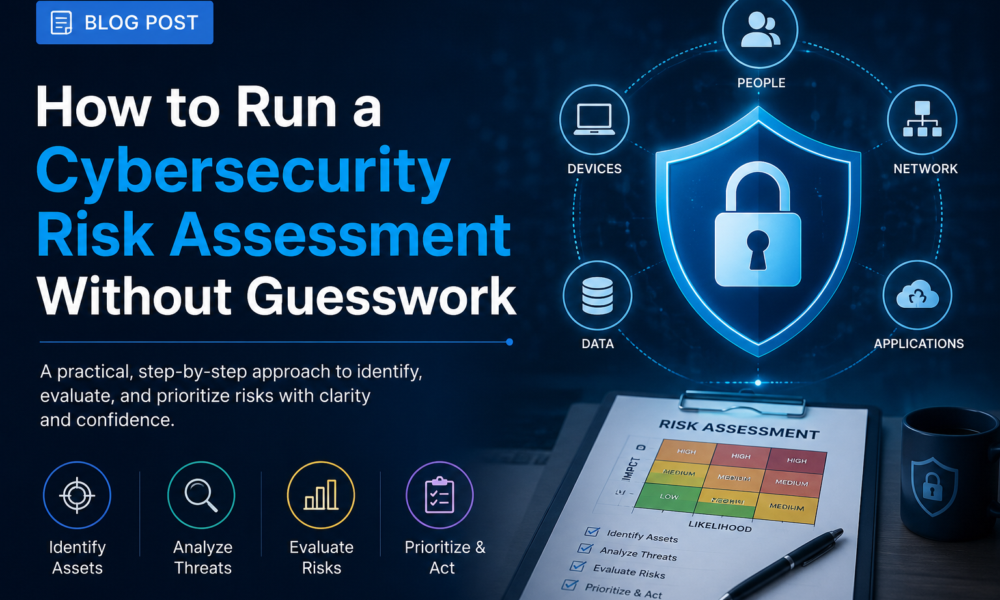
A cybersecurity risk assessment works when it replaces opinion with evidence: assets get identified, threats get matched to those assets, likelihood and impact get scored on a fixed scale, and the resulting list drives budget and remediation decisions instead of whoever spoke loudest in the last meeting. Done well, the process takes weeks, not months, and produces a ranked set of risks tied to real business consequences. Done poorly, it produces a spreadsheet nobody trusts and a compliance checkbox that expires the moment the auditor leaves the building.
That gap between the two outcomes rarely comes down to talent or budget. It comes down to method. Many teams that struggle with risk assessment cybersecurity work aren’t short on scanners or dashboards – they’re short on a repeatable way to turn raw findings into decisions a board member can actually act on. The sections below lay out what that method looks like in practice, along with the mistakes that quietly undo it.
What This Kind of Review Actually Involves
At its core, the process answers three questions: what could go wrong, how likely is that, and what would it cost if it happened. Every framework, matrix, and piece of software exists only to answer those three questions with less bias.
The Core Steps, in Order
Skipping a step is the fastest way to end up with a document that looks thorough but says nothing useful.
- Inventory assets and data flows – servers, cloud workloads, third-party integrations, and the data moving between them.
- Map threats to each specific asset, not generic industry threats copied from a template.
- Score likelihood and impact on a fixed scale so two different assessors land on comparable numbers.
- Prioritize by business impact, not by how novel or technically interesting a finding happens to be.
- Assign owners and deadlines, then track remediation like any other project with a due date.
Why Consistency Beats Complexity
A plain five-point scale applied the same way every quarter beats an elaborate model that changes shape depending on who happens to be running it that month.
Why Risk Assessment Cybersecurity Programs Quietly Fail
Most failures aren’t dramatic. They’re small, boring gaps that compound over a year until nobody trusts the output anymore.
- Asset inventories go stale. A shadow IT tool or forgotten cloud bucket never makes it into the scope, so the assessment scores a system that doesn’t reflect what’s actually running.
- Scoring criteria shift between assessors. One analyst calls a finding “high,” another calls the same class of issue “medium,” and leadership stops believing either number.
- Findings pile up without owners. A report full of red flags means little if nobody is on the hook to close them by a specific date, which is why many teams pair the assessment with a structured incident response plan to make sure findings actually get worked.
Running a cybersecurity risk assessment on a fixed schedule keeps findings comparable and budget decisions grounded in current data.
Recent industry research backs this up. A 2025 threat and risk management study from the Ponemon Institute found that formal risk assessments rose from 53 percent of organizations in 2024 to 67 percent in 2025, yet nearly three-quarters still named incomplete visibility into laptops, servers, and firewalls as the biggest obstacle. More assessments are happening; fewer are built on a complete picture of the IT footprint.
A Practical Framework for Cybersecurity Risk Assessments
Picking a framework matters less than picking one and sticking with it long enough to compare results year over year.
| Framework | Best fit | Main strength |
| NIST Risk Management Framework | Organizations needing a government-aligned, documented process | Structured, well-supported by tooling and auditors |
| ISO/IEC 27005 | Companies already running ISO 27001 | Integrates directly with existing information security management |
| FAIR (Factor Analysis of Information Risk) | Teams that need to justify budget in financial terms | Converts risk into dollar figures executives understand |
None of these frameworks removes the need for good data. They only organize how that data gets scored and reported. Organizations weighing compliance and governance support alongside a framework choice usually find the two decisions are easier to make together than separately.
Turning Scores Into a Remediation Plan
A number on a page changes nothing until it’s attached to a person, a deadline, and a budget line. That distinction is what separates real risk assessment in cybersecurity work from a once-a-year formality. Research from 2024 and 2025 backs up why it matters. ISACA’s State of Cybersecurity 2025 survey of nearly 4,000 professionals flagged cyberrisk assessments and board-level prioritization as recurring themes, and the same Ponemon research found 63 percent of organizations named an internal review of security processes and governance as the top investment planned for the coming year.
Building a Process That Doesn’t Rely on Guesswork
Guesswork creeps in wherever data is missing, outdated, or inconsistent across teams. Closing those gaps is less about buying more tools and more about tightening the process around the tools already in place. Strong risk assessment cybersecurity practices depend far more on data discipline than on which vendor logo sits on the dashboard, and that discipline is exactly what separates solid risk assessment in cybersecurity from a paperwork exercise.
Tools and Data Sources That Actually Reduce Guesswork
A handful of practices consistently separate cybersecurity risk assessments that hold up under scrutiny from ones that don’t:
- Automated asset discovery that runs continuously instead of once a year.
- Vulnerability scanning tied directly to the asset inventory, not a separate spreadsheet.
- A documented scoring rubric shared across every assessor on the team.
- Regular review cycles – quarterly at minimum – rather than a single annual snapshot.
Teams working through ongoing vulnerability management often find that the assessment itself becomes far more reliable once discovery and scanning feed the same data set instead of running as separate exercises. For organizations building or refreshing a security risk management program, that alignment between data collection and scoring is usually the single biggest lever for accuracy.
Making Guesswork the Exception, Not the Default
Getting this kind of assessment right is less about finding a perfect framework and more about building a process that produces the same trustworthy answer every time it’s run. Accusights works with organizations to build that kind of repeatable assessment process, from asset discovery through to a prioritized remediation plan a board will actually sign off on. Reach out to talk through what the current setup looks like and where the guesswork is most likely hiding.
Frequently Asked Questions
What does this kind of assessment actually cover?
It’s a structured review that identifies an organization’s assets, the threats and vulnerabilities facing them, and the likelihood and business impact of each one, resulting in a prioritized list for remediation.
How often should this kind of assessment be done?
Most mature programs run a full review at least annually, with lighter reviews quarterly or after any major change to infrastructure, such as a new cloud deployment or acquisition.
What’s the difference between cybersecurity risk assessments and vulnerability assessments?
A vulnerability assessment lists technical weaknesses. This kind of review goes further, weighing those weaknesses against business impact and likelihood to decide what to fix first.
Who should be responsible for running this kind of assessment?
Ownership typically sits with a CISO or IT security lead, but input from asset owners, compliance, and finance teams keeps risk assessment in cybersecurity grounded in real business impact rather than technical opinion alone.
What are the main steps involved in this process?
Asset inventory, threat and vulnerability identification, likelihood and impact scoring, prioritization by business consequence, and assigning owners and deadlines for remediation.