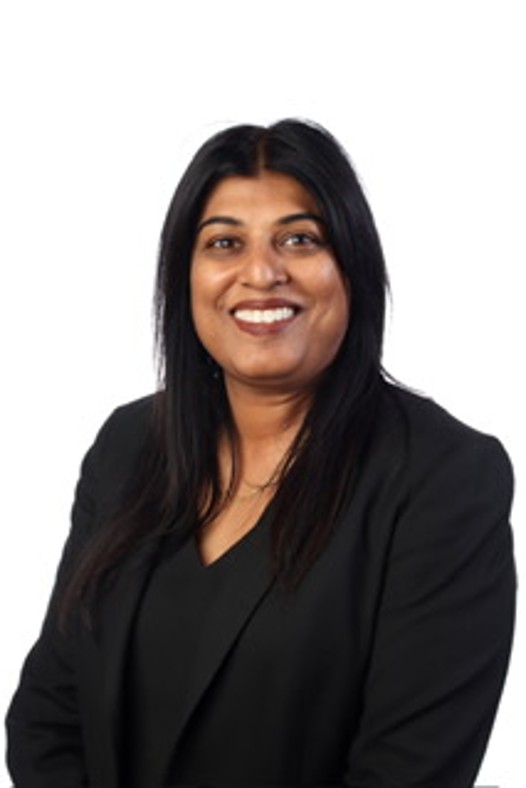
Our education system is strongest when every teacher, leader and student can see themselves represented — and can thrive. This series shares the lived experiences of teachers and leaders from underrepresented groups across schools and further education. Their stories are motivating and deeply human: they celebrate successes, confront challenges, and offer practical insight drawn from real journeys through the profession.
By amplifying these voices, we aim to inspire those already working in education, support the sharing of meaningful best practice, and encourage others to join a profession that needs — and values — them. The DfE is committed to building a diverse, representative workforce where everyone belongs. These case studies show what that can look like in action.
Growing up with purpose
I was born and raised under apartheid in South Africa, as a fourth-generation South African Indian. Growing up in a society that treated me as a second-class citizen shaped everything about me. Education was about improving life chances — it was about survival.
Even in tough times, education was never optional. It was the key to a better future. My childhood was shaped by strong women and even stronger values. My mother was a teacher, my paternal grandmother a community leader and both believed in the power of education. They instilled in me the values of service and leadership: “Service to others before service to self — that’s how I was raised.”
Finding my feet in the UK
I arrived in England in 2000 at the age of 25, with no prior teaching experience outside South Africa. I started as a supply teacher across North-West London and quickly noticed stark differences in school culture. The experience was jarring. There was a lack of respect for teachers, and pupils were unruly.
My early years in the UK were marked by a constant need to prove myself —especially as an ethnic minority teacher. My accent, my background, and even my appearance was often used to judge my capabilities. I had to be the best just to be considered. I worked hard, proved myself, and kept going even when people judged me by my accent or appearance.
Later, I taught in Bushey, Hertfordshire, where I encountered both professional challenges and cultural misunderstandings. I had to prove my quality as a teacher. I had to be the best in the classroom just to be seen. My mum’s words stayed with me: “This is not a job. You’re going into service.” That gave me the deep sense of purpose and resilience I needed.
Breaking through the barriers to leadership
Despite my qualifications and success in the classroom, I faced repeated rejections when applying for leadership roles — often with feedback that was explicitly discriminatory. I was told, “You wouldn’t fit our community context.” Another said, “Your skin colour wouldn’t suit our school.” It was also evident that applications to leadership posts were more successful when I identified as‘Jess’ rather than my full name‘Jessantha’ which lacked‘Britishness’.
It wasn’t until I applied to Denbigh High School in Luton that I was given the opportunity to lead. I found a school community that valued education and respected teachers. It aligned with the expectations I had from South Africa. Luton was the first place where I felt seen, valued, and understood.
Making an impact
I eventually secured my first deputy headship and later became a headteacher at Lea Manor, a school in one of the most deprived areas of the country, Marsh Farm. But I see potential, not problems. For me, it’s not just a job. It’s my service to Marsh Farm. I’ve committed to them, so I’ve got to get the job done.
My leadership has already made a tangible impact. Last year, we had 100% of our pupils apply to sixth form or apprenticeships. That wasn’t the case three years ago. I’m proud of what we’ve achieved. We’re exposing children to what’s beyond Marsh Farm and helping them realise their potential.
The importance of role models
I’m ardent about the importance of representation in schools for both staff and students. It’s incredibly important for pupils to see leaders who look like them. It gives them a sense of aspiration.
My values are shaped by strong female role models. I credit my grandmother, mother, and the women, especially those of colour who I work with in Luton as my role models—for their commitment to uplifting their communities. My role models weren’t always people above me in authority. and I pay homage to the cleaning ladies, the lunchtime-dinner ladies and the struggling, marginalised mothers I met along the way. They too were women who worked tirelessly to serve others.
Aspiration for a more representative leadership
While gender has been a barrier in my journey, race continues to be the more profound obstacle. Most headteachers in South Africa were men and that is also the case here. But race still limits access to leadership. There’s more representation in teaching now, but leadership still lacks diversity. The dial hasn’t moved far enough.
I’m hopeful about the future, but honest about the challenges. In Luton, where diversity is celebrated, ethnic minority teachers are embraced. But in other areas, I experienced hostility and misunderstanding. My identity has often been misunderstood—both by students and parents who expected me to align with their cultural norms, and by colleagues who underestimated me. In the UK, I went from being South African Indian to being part of a generic ‘Asian’ community.
My leadership is grounded in empathy, lived experience, and a deep sense of community. I don’t just lead a school; I contribute to uplifting a generation. Good days are great. Bad days are horrific. But I keep going because I know I’m making a difference.
The Department for Education is committed to ensuring that every school and college models inclusive behaviours and fosters an environment where everyone is treated equally.
To support this, the Department has published a new resource to help leaders understand their responsibilities under the Equality Act 2010, pulling together the key information in one place and highlighting areas of practice to consider.