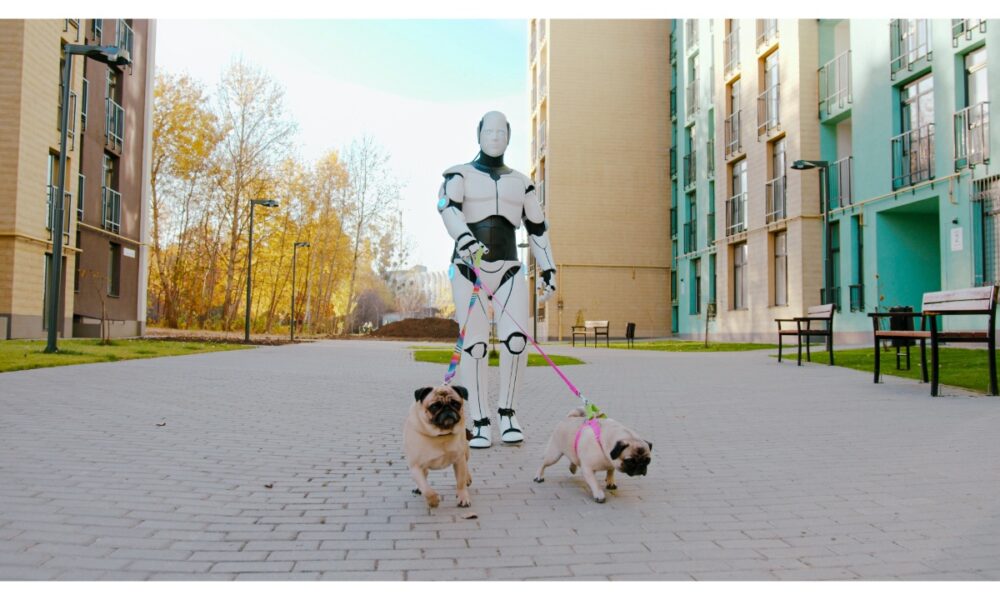
Nvidia just gave humanoid robotics a common blueprint at Computex in Taipei, stitching together a Unitree chassis, Sharpa’s five-fingered hands, and its own Jetson AGX Thor brain into a research-ready template. The pitch is simple: an open, reproducible setup so labs stop reinventing the knee joint and start tackling useful work for future factories. Early adopters include the Allen Institute for AI, ETH Zurich, and Stanford, a signal that this could spread fast. If it sticks, GR00T might do for humanoids what Android did for smartphones, not by dazzling specs alone but by standardizing the starting line.
Nvidia’s announcement sets the stage for robotics innovation
Robotics labs spend months cobbling together hardware just to run baseline experiments. That hurdle could shrink after Nvidia unveiled the Isaac GR00T Reference Humanoid Robot at Computex in Taipei. The company framed it as a turnkey research platform for humanoids destined for factory work. The timing fits its broader AI push, where compute, simulation, and real-world robotics increasingly converge.
A closer look at the humanoid robot’s design
The reference model stands about 5 feet 11 inches (1.8 meters) and weighs roughly 150 pounds (68 kg), using a Unitree-built chassis. It provides 31 degrees of freedom for agile motion. Sharpa-designed hands offer five tactile fingers and can lift up to 33 pounds. With vision and environmental sensors onboard, it is powered by Nvidia’s Jetson AGX Thor T5000 and runs on the Isaac GR00T software stack tailored for humanoid control and training.
Bridging robotics research with open platforms
Nvidia positions Isaac GR00T as an open, end-to-end path from simulation to deployment, intended for universities and labs that want to skip custom chassis builds and focus on behavior, dexterity, and autonomy. Availability is planned by year-end. Early adopters include the Allen Institute for AI in Seattle, Stanford’s robotics community, and ETH Zurich, which are integrating the design into ongoing humanoid research.
NVIDIA announces the first open humanoid robot reference design built for robotics research.
The NVIDIA Isaac GR00T Reference Humanoid Robot combines the @UnitreeRobotics H2 humanoid robot, @SharpaRobotics Wave five-fingered hands for dexterous manipulation, Jetson Thor onboard… pic.twitter.com/iQU6n8EIOs
— NVIDIA Robotics (@NVIDIARobotics) June 1, 2026
Dieter Fox, a senior research director at the Allen Institute for AI, said the setup provides the hardware and software backbone needed for broad robotics experiments. That aligns with what many US labs want: less time wrestling with drivers and more time iterating on manipulation, perception, and safety policies.
The potential ripple effects on robotics adoption
If researchers rally around a common reference, shared datasets and reproducible benchmarks become easier. That can speed progress on factory-floor tasks such as bin picking, pallet handling, and line-side inspection. The model could also help midsize US manufacturers test humanoid workflows without assembling bespoke rigs first, a practical step toward evaluating ROI before pilots.
There is a strategic arc here too. With Jensen Huang, CEO, tying humanoids to Nvidia’s AI pipeline, a standardized platform could echo how Android unified early smartphone development. The analogy has limits, but a widely used baseline can concentrate talent and tools. Watch for US pilots in 2026 as labs move prototypes from sim to shop floor.