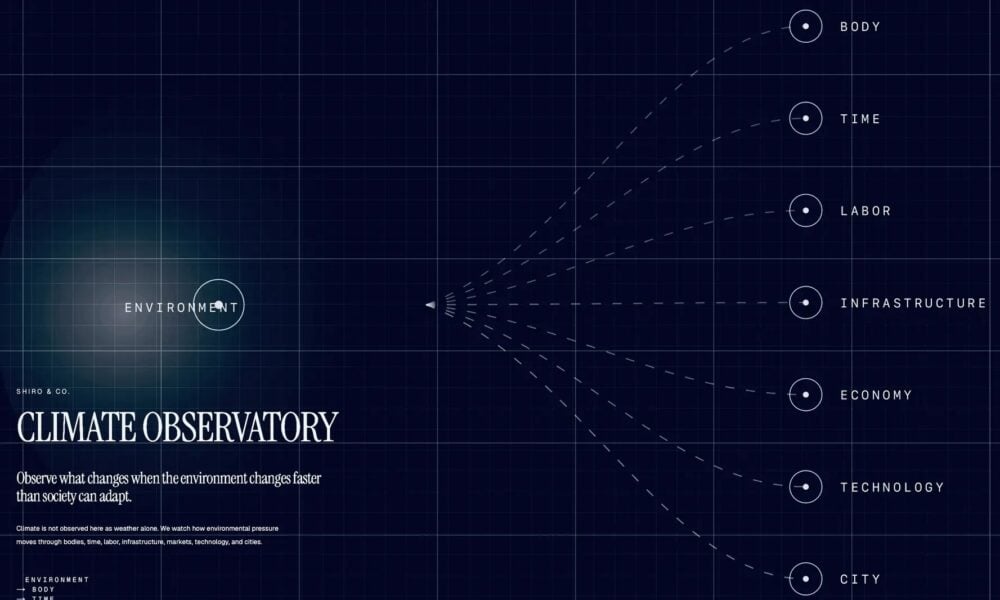
SHIRO & Co., an independent research and design initiative, has released an applied observation developed through its Kosuke Protocol, reframing extreme heat not merely as rising thermometer temperatures, but as an acute loss of usable human time. Entitled Climate Temporal Compression, the framework evaluates climate risk through the operational reality that while climate change alters temperature, economies operate strictly within the constraints of time.
To test this premise, SHIRO & Co.’s Climate Observatory conducted an experimental usable-time assessment evaluating outdoor labor conditions across Kochi City and Tokyo. Utilizing hourly estimated Wet Bulb Globe Temperature (WBGT) data published by Japan’s Ministry of the Environment, the study analyzed 53 consecutive days from July 1 to August 22, 2026. The findings demonstrate that even under identical nominal working hours and standard national clock time, prevailing climate conditions generate stark regional disparities in actual operating capacity—a phenomenon SHIRO & Co. defines as Temporal Geography.
The 53-Day Experimental Findings
The experimental model revealed marked operational divergence between the two Japanese metropolitan areas:
- Median Usable-Time Loss: Kochi registered an estimated median loss of 1.0 hour per workday, compared to 0.0 hours in Tokyo.
- Maximum Usable-Time Loss: Both Kochi and Tokyo recorded single-day peak losses reaching 7.0 hours.
- Days Under Severe Heat Constraint: Kochi experienced 28 days classified as “very-high constraint,” while Tokyo logged 19 days.
- Zero-Loss Days: Tokyo recorded 34 days with zero modeled usable-time loss, compared to 25 days in Kochi.
The operational contrast became particularly pronounced on July 28, 2026. On that date, the model estimated 6.0 hours of lost usable time during the standard outdoor workday in Kochi—allowing safe work only between 08:00–10:00, while restricting activity between 10:00–12:00 and 13:00–17:00 (with 12:00–13:00 treated as standard rest). In Tokyo, the identical methodology showed 0.0 hours of lost time on the exact same calendar day, permitting uninterrupted outdoor activity across the full standard schedule.
Redefining Labor Scarcity: ‘The Missing Worker Hour’
Most enterprises assess operational capacity via traditional balance-sheet inputs such as workforce headcount, capital, equipment, and fixed physical assets. SHIRO & Co.’s Climate Observatory introduces an unmodeled variable: the proportion of scheduled hours that remain realistically and safely usable under local climatic stress.
The Observatory defines Usable Time as the window during which a specific human, biological, or economic activity can be executed safely under prevailing conditions. When extreme heat compresses this window, organizations experience Temporal Scarcity.
This dynamic shifts the labor discussion from headcounts to what SHIRO & Co. terms “The Missing Worker Hour.”
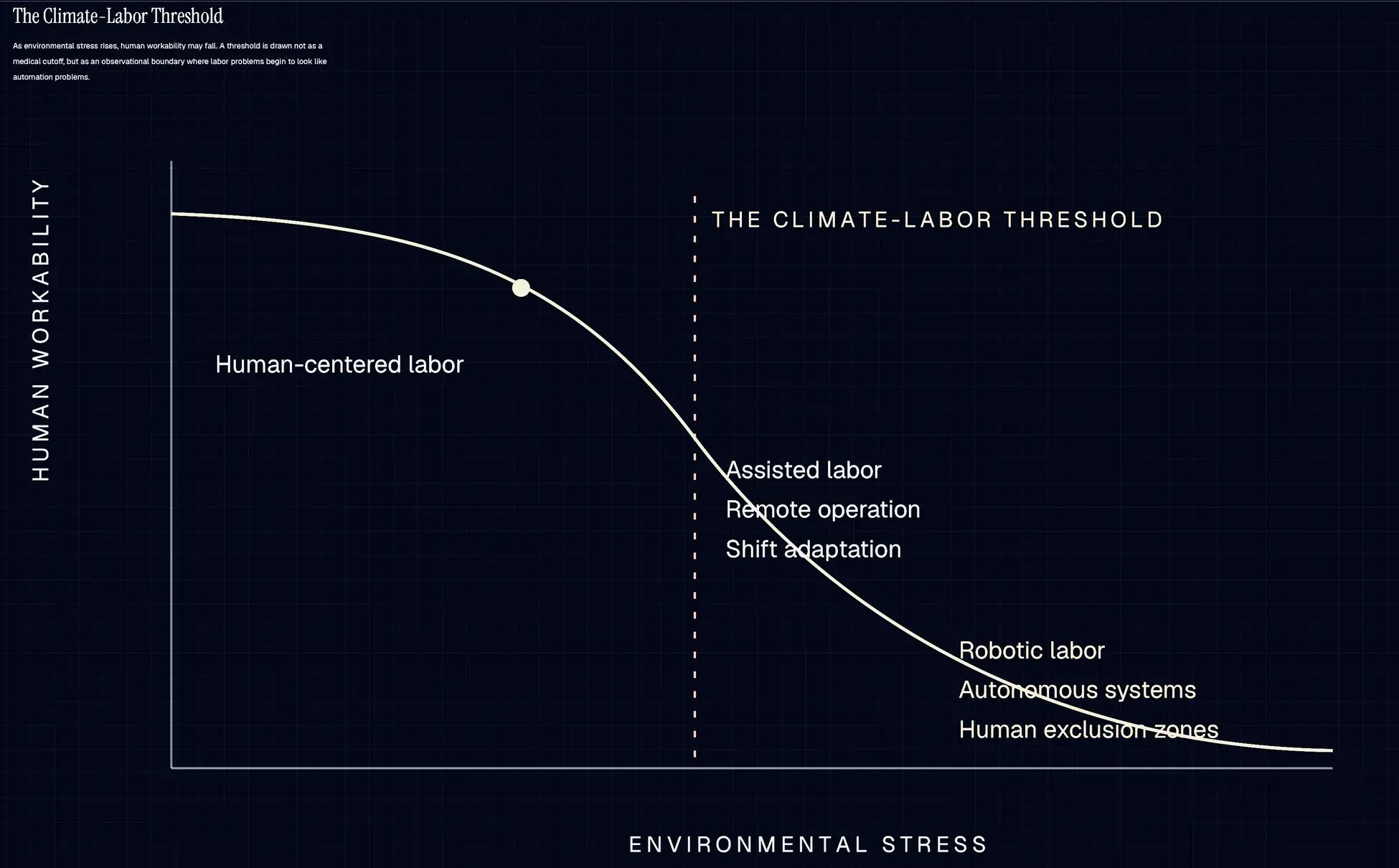
Under this model, climate exposure threatens organizational capacity well before physical infrastructure or equipment suffer tangible damage. For multi-site enterprises, regional heat divergence creates asymmetric capacity, directly influencing project deadlines, workforce orchestration, and regional expansion.
Furthermore, this dynamic fundamentally recalculates the business case for industrial robotics and remote operation. The economic equation moves beyond comparing robot acquisition costs against base wages, shifting toward evaluating automation capital costs against the escalating total expense of maintaining safe human presence in climatically hostile environments.
Institutional Adaptation vs. Modeled Loss
The study highlights an existing institutional response in Kochi Prefecture, which established a formal “Cool Work Time” guideline for prefectural public works construction. Applicable from June 1 to September 30, the guideline calls for outdoor construction to halt between 11:00 and 14:00, recommending operating windows of 08:00–11:00 and 14:00–17:00. The policy officially recognizes a daily working reduction of approximately two hours and authorizes commensurate extensions of project deadlines.
SHIRO & Co. documents the Kochi public works rule as an observed institutional adaptation, noting that it remains methodologically distinct from the Climate Observatory’s purely climate-derived WBGT data models.
Time Competition and Time as Infrastructure
As daytime heat escalates, human and commercial activities inevitably migrate toward early morning, twilight, or evening hours. However, the Climate Observatory emphasizes that cooler hours represent a finite, non-renewable resource subject to intensifying Time Competition. Outdoor construction, civic life, biological rest and physiological recovery, and agricultural production all converge on the same shrinking thermal windows.
Consequently, climate adaptation expands beyond mechanical cooling equipment to encompass the strategic allocation of viable operating hours. Under this emerging paradigm—termed Time as Infrastructure—access to climatically viable operational windows functions as a proprietary economic asset. Standardized clock time remains uniform, but usable time remains localized.
The Climate Usable Time Assessment is an experimental climate-observation tool and does not establish legal workability, occupational safety compliance, individual heatstroke risk, or formal work-suspension mandates.
A public press demonstration, complete comparative datasets, and interactive models are available at:
https://www.shiroand.io/climate-temporal-compression
About SHIRO & Co.
SHIRO & Co. is an independent research and design project that observes emerging structural shifts across technology, society, markets, climate, and human behavior. Through its proprietary Kosuke Protocol, the initiative synthesizes fragmented signals into structured observations, patterns, simulations, and actionable enterprise opportunities, aiming to identify transformative systemic shifts before they materialize as established categories.