Share
Share
Share
Share
Have you ever thought about why some projects finish on time while others keep facing delays? Successful project delivery depends on careful planning and knowing which activities matter the most. PMP Courses help professionals understand proven techniques that improve planning and project control. One of the most valuable methods is the Critical Path Method, which helps teams identify tasks that directly affect the project timeline.
In this blog, we will understand what the Critical Path Method in PMP and the role of the Critical Path Method in PMP is.
Table of Contents
- What is the Critical Path Method in PMP?
- Understanding the Role of the Critical Path Method in PMP
- Conclusion
What is the Critical Path Method in PMP?
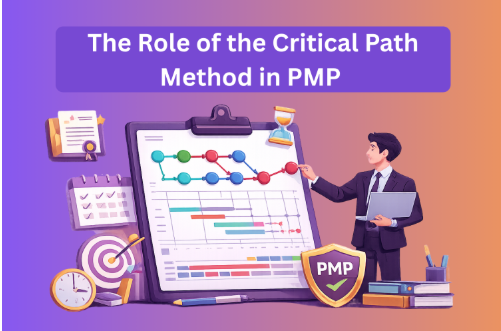
Critical Path Method in PMP is a project scheduling technique used to find the order of actions that will result in the shortest time required to finish a project. It concentrates on work for which there is no additional time, hence any delay in these jobs will cause the project as a whole to be delayed. Project managers can prioritise crucial tasks and track advancement more precisely by determining the essential path. This approach facilitates better planning and guarantees that projects are finished on time.
Understanding the Role of the Critical Path Method in PMP
Below are the key roles the Critical Path Method in PMP plays in improving project planning and successful project delivery:
Identifies the Most Important Tasks
The relevance of each project activity varies. While certain jobs allow for greater flexibility, others have a direct impact on the project’s completion timeline.
These crucial tasks are identified via the Critical Path Method. After that, project managers can make sure they stay on time and give them special attention. This enhances project performance and cuts down on needless delays.
Supports Better Resource Management
Every project has a certain number of participants and time. Project Managers can allocate resources where they are most required by using the Critical Path Method.
Rather than distributing resources equally among all tasks, emphasis is placed on crucial tasks that affect project completion. This decreases wasted work and increases efficiency.
Reduces the Risk of Delays
Any endeavour may encounter unforeseen problems. Even a minor delay can have an impact on the final delivery date if sufficient planning is not done.
The Critical Path Method in PMP identifies the tasks that cannot be postponed without impacting the schedule as a whole. This reduces project risks and enables project managers to act fast when issues emerge.
Helps Monitor Project Progress
Knowing which tasks need to be closely watched makes it considerably easier for project managers to track progress. Throughout the project’s execution, the Critical Path Method offers a clear picture of its state.
When planned and actual progress diverge, managers can swiftly make the necessary corrections. This keeps initiatives headed in the proper path.
Improves Decision Making
When objectives shift, project managers frequently have to make snap judgements. The Critical Path Method offers trustworthy data that facilitates improved decision-making.
Managers can assess the effects of changes before making changes by knowing which tasks are crucial. Decisions are made with greater assurance and knowledge as a result.
Strengthens Team Communication
Effective project management requires clear communication. Every stakeholder has a common knowledge of project priorities thanks to Critical Path Method in PMP.
Team members are aware of which jobs need to be completed right away and which can wait. This lessens miscommunication during the process.
Supports Effective Risk Management
Understanding where delays are most likely to cause issues makes risk management easier for project managers. The Critical Path Method identifies regions that need more careful observation.
Teams can detect any problems early and plan appropriate solutions before they impact the entire timetable by concentrating on important tasks.
Increases Project Success Rates
Accurate planning and focused execution increase a project’s chances of success. Critical Path Method in PMP offers an organised method for maintaining project organisation from start to finish.
It supports teams in meeting deadlines and completing projects on schedule. Stronger business results and increased consumer happiness are the result of this.
Conclusion
The Critical Path Method in PMP remains one of the most effective scheduling techniques for delivering projects successfully. It improves planning and reduces the risk of delays.
Professionals looking to build stronger project management skills can expand their knowledge through PMP Courses with the best training provider, The Knowledge Academy, helping them manage complex projects with greater confidence and achieve consistent project success.