
Share
Share
Share
Share
Cryptocurrency has become a global asset class, but one of the industry’s biggest ambitions remains surprisingly unfinished: making digital assets genuinely practical for everyday payments.
Millions of people can buy, sell and transfer cryptocurrency, yet paying for ordinary products and services with digital assets is still far less seamless than using conventional payment methods. For crypto to become a larger part of global commerce, the experience needs to move beyond trading platforms and complicated wallet transactions and become something consumers and merchants can use naturally.
Veraxum is building its strategy around that transition.
Through its planned combination of cryptocurrency payments, e-commerce, mobile functionality and merchant services, Veraxum is seeking to create an environment where digital assets can become part of practical commercial activity. VER, the project’s native token, is intended to participate in this economy alongside a broader infrastructure designed to connect blockchain with real-world transactions.
The objective is straightforward but ambitious: make cryptocurrency useful at the point where digital value meets actual commerce.
Crypto’s Payment Opportunity Is Still Developing
Cryptocurrency has demonstrated that value can move directly across blockchain networks without relying entirely on traditional financial infrastructure. What remains more difficult is turning that capability into a payment experience suitable for mainstream commerce.
Consumers expect payments to be fast and convenient. Merchants need systems that fit naturally into the way they conduct business. Neither group wants unnecessary technical complexity.
This creates an important distinction between a cryptocurrency being technically transferable and being practically useful as a payment method.
Veraxum is targeting the second challenge.
Instead of treating payments as an isolated blockchain function, the project plans to integrate them into a broader commerce ecosystem. The idea is to give digital assets a practical destination: transactions involving products, services, merchants and other users.
That approach puts real-world utility at the center of the Veraxum strategy.
Bringing Digital Assets Closer to the Checkout
For many cryptocurrency holders, digital assets still exist largely inside exchanges and wallets.
They may be purchased as investments, transferred between accounts or traded for other cryptocurrencies, but their relationship with everyday spending remains limited.
Veraxum is attempting to shorten the distance between owning cryptocurrency and using it.
Its planned payment infrastructure is designed to complement the project’s wider e-commerce strategy, creating a pathway where blockchain-based assets can participate more directly in commercial transactions.
This matters because the checkout is one of the most important points in any e-commerce ecosystem. It is where technology either becomes useful or creates friction.
A successful crypto payment experience therefore cannot depend solely on blockchain capabilities. It also needs to consider simplicity, accessibility and the expectations consumers already have from digital commerce.
Veraxum’s broader product direction reflects this requirement by combining payment functionality with mobile access and marketplace infrastructure rather than presenting crypto payments as a standalone technical feature.
Merchants Are Critical to Real Adoption
Consumer interest alone cannot create a functioning payment economy.
There must also be somewhere to spend digital assets.
This makes merchant participation an important part of Veraxum’s long-term strategy. Businesses form the other side of every commercial transaction, and widespread crypto payment adoption will depend heavily on whether blockchain-based payment systems can offer merchants a compelling and manageable experience.
For merchants, cryptocurrency potentially introduces another route for reaching customers who already hold digital assets. It can also provide access to a payment infrastructure built for a digital economy that increasingly operates across national borders.
Veraxum is attempting to build merchant services into its wider ecosystem rather than expecting businesses to navigate blockchain infrastructure independently.
That distinction could be important.
Most merchants are not blockchain developers, nor should they need to become blockchain experts simply to accept a new form of digital payment. The closer cryptocurrency infrastructure moves toward the simplicity businesses expect from existing payment solutions, the more realistic broader commercial adoption becomes.
Cross-Border Commerce Creates a Natural Use Case
E-commerce has become increasingly international, but the payment systems behind it still frequently reflect a world divided by national banking networks, currencies and financial intermediaries.
A buyer can discover a merchant on the other side of the world almost instantly. Moving money between them may be considerably more complicated.
Blockchain technology introduces a fundamentally global transaction layer, which makes cross-border commerce one of the more natural areas for cryptocurrency payments.
This is particularly relevant to Veraxum because the project is positioning itself around global e-commerce rather than a single local marketplace.
A blockchain-based payment ecosystem can potentially allow users from different markets to interact through the same underlying infrastructure. Instead of digital assets being limited by the geographic boundaries that affect many traditional payment systems, they can move through networks designed to operate internationally.
Veraxum’s combination of payments, P2P transactions and e-commerce is intended to take advantage of that characteristic.
The opportunity is not simply to provide another payment button. It is to create an ecosystem designed from the beginning around digitally native, globally accessible value.
Mobile Payments Could Make Crypto More Practical
Another important part of the strategy is mobile access.
Modern commerce increasingly happens through smartphones. Consumers browse products, communicate with businesses, manage financial accounts and complete purchases without ever opening a desktop computer.
Any cryptocurrency ecosystem targeting practical adoption therefore needs to consider how users will interact with it during everyday life.
Veraxum’s planned mobile application is intended to provide access to multiple parts of its ecosystem, including payments, digital assets, transactions, marketplace services, rewards and peer-to-peer functionality.
For crypto payments, that could be particularly important.
Instead of requiring users to move between unrelated platforms, wallets and services, the goal is to create a more unified experience where payment functionality exists alongside the other features users need.
Convenience may ultimately matter just as much as blockchain technology itself.
Consumers generally adopt payment methods because they are useful and easy, not because they understand the infrastructure operating underneath them. Veraxum’s challenge will therefore be to make blockchain functionality increasingly invisible within the user experience.
A Broader Payment Strategy
Veraxum’s payment ambitions are not necessarily limited to VER.
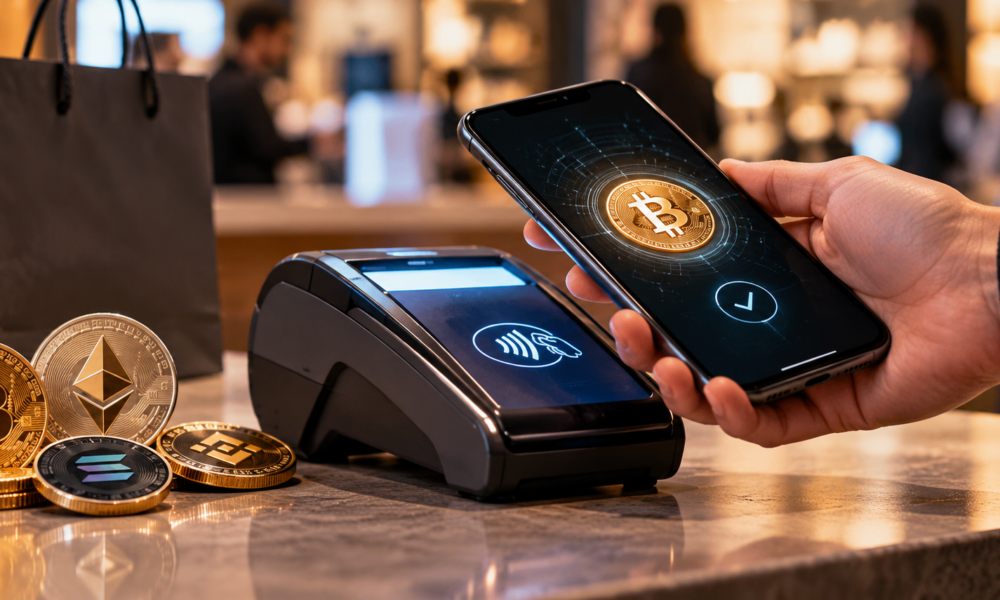
The project’s broader payment concept has contemplated support for major cryptocurrencies such as Bitcoin, Ethereum and BNB alongside its native ecosystem token.
This creates a different approach from building a payment system that requires every participant to use only one asset.
Crypto holders already maintain portfolios across multiple blockchain assets. Providing greater flexibility could make a commerce platform more accessible to users entering the ecosystem with cryptocurrencies they already own.
VER can then occupy a different position.
Rather than relying solely on exclusivity, the native token can derive utility from its deeper relationship with the Veraxum ecosystem, including potential interactions with payments, rewards, marketplace participation and P2P activity.
That distinction allows Veraxum to pursue broader crypto payment accessibility while continuing to develop specific utility around VER.
From Payments to Continued Participation
A transaction does not necessarily need to represent the end of the customer relationship.
Veraxum’s planned rewards system introduces another dimension to its payment strategy by potentially connecting purchases with continued ecosystem participation.
In traditional commerce, loyalty programs attempt to encourage customers to return after making a purchase. Veraxum is exploring how that concept can operate within a blockchain environment.
A user might enter the ecosystem because they want to make a cryptocurrency payment, but the broader platform is designed to give them additional reasons to remain active through marketplace services, rewards, transfers and other functionality.
This turns payments into an entry point rather than an isolated feature.
That could prove important because real-world crypto adoption is unlikely to emerge from a single use case. It is more likely to develop when multiple useful activities become connected and users no longer need to leave the ecosystem after completing one transaction.
The Path From Crypto Ownership to Crypto Usage
Veraxum is entering a market where the technological ability to transfer cryptocurrency already exists. Its larger challenge is making those transfers useful in a commercial context.
Building the infrastructure is only part of that process. The project will also need to attract merchants, deliver intuitive products, create a reliable user experience and demonstrate why consumers should choose blockchain-based payments when familiar alternatives already exist.
Those are significant execution challenges, but they also highlight what makes the Veraxum strategy notable.
The project is not approaching payments simply as another feature attached to VER. Payments form part of a broader attempt to connect cryptocurrency with e-commerce, merchants, consumers, mobile technology and international transactions.
If that infrastructure develops as planned, Veraxum could provide VER and other supported digital assets with something the crypto industry has spent years pursuing: more opportunities to be used rather than simply held.
That is the real-world adoption opportunity Veraxum is targeting.
The next phase will depend on transforming its payment vision into accessible products that can serve both sides of digital commerce. For Veraxum, success would mean making the distinction between cryptocurrency and everyday digital payments increasingly smaller — until using blockchain-based value becomes another natural part of buying, selling and transacting online.
For more information, visit: https://veraxum.net
For information purposes only. Crypto carries risk. Not financial advice!