The text arrives at 9 in the morning: your bank asking if you just spent 600 dollars on gift cards two states away. You did not, and a tap on “no” freezes the card before the second charge clears. That quiet exchange is fraud detection systems at work, and for consumers and businesses in the USA the stakes have never been higher. The Federal Trade Commission reported that consumers lost more than USD 12.5 billion to fraud in 2024, a 25% increase over the prior year, according to FTC data.
What fraud detection systems do
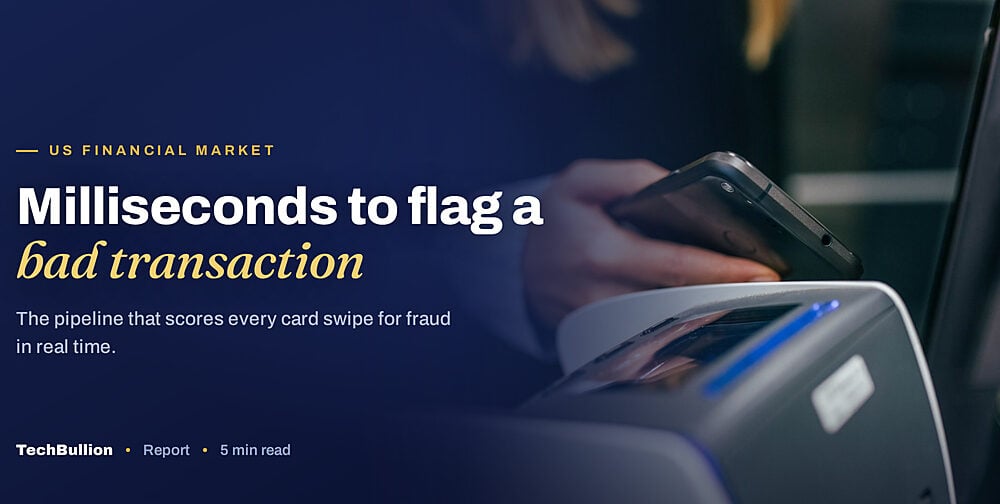
A fraud detection system watches activity and decides, in real time, whether each action looks normal or suspect. Every card swipe, login, and transfer is scored against the pattern of how that account usually behaves. A purchase that fits the pattern clears instantly. One that does not gets challenged, held, or blocked, often before the customer notices anything happened.
Scale is what makes the task hard. A large US card network can process tens of thousands of transactions every second, and the system has to judge each one in the time it takes a terminal to beep. That demand for speed at volume is why fraud detection became one of the earliest and most mature uses of machine learning in finance.
The goal is a balance. Block too little and losses pile up. Block too much and legitimate customers get declined at the register, which costs the business sales and trust. The art of these systems is catching the real fraud while waving through the millions of genuine transactions that look unusual only because life is unusual sometimes.
How the technology works
Older systems ran on fixed rules, such as flagging any purchase above a set amount or from a new country. Rules still matter, but they are blunt, and fraudsters learn them quickly. Modern systems add machine learning that scores each event on dozens of signals at once: the device, the location, the time, the amount, and how it all compares to the account history.
Most systems work in layers. A first pass uses fast rules to clear the obvious cases. A second pass runs the machine learning score on anything ambiguous. A third pass, reserved for the highest risk events, may add a step up check such as a one time code or a prompt in the banking app. Each layer filters the volume so that human investigators only ever see the small slice of cases that the machines cannot settle on their own.
The newest threat changes the math. The same generative tools that help defenders also help attackers write flawless phishing messages and clone voices, a shift covered in this look at how online fraud surges as digital identities grow more sophisticated. Email remains the front door for many scams, which is why defenses now reach into the inbox, as explored in this report on the reality of AI email security in 2026. Behind both sits the broader wave of agentic AI tools entering the finance industry.
What it means for consumers
For individuals, the system is mostly invisible until it acts. Its benefits are real: faster catches, automatic alerts, and in most cases reimbursement when a card is used fraudulently. Its costs are smaller but familiar, such as a card declined on holiday or a transfer delayed for review. The trade is usually worth it, because the alternative is absorbing the loss alone.
Consumers still carry part of the load. Investment scams, which often start with a friendly message and a fake platform, were the single largest category of reported losses at USD 5.7 billion in 2024. No detection system stops a victim who is persuaded to send money willingly, which is why awareness remains the first line of defense. People over 60 reported some of the heaviest losses, a reminder that scams target trust as much as technology.
What it means for US businesses
For companies, fraud is both a direct loss and a reputation risk. A breach that drains customer accounts can do lasting damage even after the money is recovered. So businesses invest heavily, and the market reflects it. The global fraud detection and prevention market is projected to grow from USD 32.00 billion in 2025 to USD 65.68 billion by 2030, a 15.5% annual rate, MarketsandMarkets reports.
False positives are the hidden tax of fraud defense. Every legitimate sale that a system wrongly blocks is a lost customer and a support call, and for an online merchant those declines can cost more than the fraud itself. So businesses tune their systems not just to catch theft but to minimize the friction felt by honest buyers, a balance that shifts with every new product and payment method they add.
The cost of inaction is visible in the national totals. The FBI Internet Crime Complaint Center logged record losses in its most recent annual report, the FBI announced, with business email compromise among the most expensive categories. For a mid sized firm, a single compromised invoice can erase a quarter of profit, which is why fraud defense has moved from the security team to the boardroom.
Where fraud detection is heading
The next phase is a contest of models. As attackers automate, defenders respond with systems that learn faster and share signals across institutions, so a scam pattern caught at one bank warns the others. Expect more verification that happens in the background, such as device and behavior checks that confirm identity without asking the customer to do anything.
Identity is becoming the new battleground. As synthetic identities, built from stitched together real and fake details, slip past traditional checks, banks are turning to behavioral signals that are hard to fake, such as how a person types or holds a phone. These passive signals promise stronger security with less friction, though they raise fresh questions about privacy that regulators are only beginning to address.
The honest truth is that fraud will not be solved, only managed. The institutions that manage it best will treat detection as a living system, retrained constantly and paired with human investigators on the hardest cases. For consumers and businesses alike, the safest assumption is that the next scam will look a little different from the last one, and that the systems guarding against it have to keep learning to stay one step ahead.