The State of Bitcoin Mining Profitability in 2026
Two years after the block reward was cut in half, the mining industry has quietly reorganised itself around a single number: the cost of electricity. In 2026, bitcoin mining profitability is no longer decided by who owns the newest machines — almost every serious operator now runs comparable next-generation ASICs. It is decided by the cost per bitcoin, and that cost is dominated by power.
This report models mining returns across realistic Bitcoin-price, network-hashrate and electricity-cost scenarios, then benchmarks OneMiners against traditional hosting. The pattern is consistent across every case we ran: locking in low, fixed electricity at industrial scale is the single highest-leverage decision a miner can make.
What separates the winners from everyone else in 2026:
- Energy certainty — a fixed, multi-year electricity rate instead of a floating one exposed to grid spikes.
- Scale — utility-grade power contracts that small co-location shops simply cannot access.
- Uptime — guaranteed availability so machines keep mining through difficulty waves.
- Protection — warranty and insurance bundled in, not billed as expensive add-ons.
Post-Halving Economics: A Different Game
When the block subsidy dropped to 3.125 BTC, every miner’s revenue per unit of hashrate fell overnight while the network’s energy appetite did not. The result is a market where the spread between your electricity rate and the network average effectively is your margin. Two operators running identical hardware can sit on opposite sides of profitability purely because one pays $0.04/kWh and the other pays $0.10/kWh.
Rising hashrate compounds the pressure. As more efficient machines come online, difficulty climbs and each terahash earns fewer sats — a trend visible in the global Bitcoin network hashrate. The miners who compound through this are those who fixed their input costs years in advance, insulating themselves from both energy-price spikes and difficulty growth.
Electricity Is Now 70–90% of the Cost Per Bitcoin
Hardware is a one-time purchase; power is the bill that never stops. Across a modern machine’s working life, electricity now accounts for 70–90% of total operating cost — which is why your dollar-per-kilowatt-hour, not your machine model, ultimately decides your return. The table below holds the hardware constant and flexes only the electricity rate.
| Rate ($/kWh) | Provider type | 7-yr electricity / rig | 7-yr ROI | Status |
| $0.0364 | OneMiners — Nigeria | $7,420 | ~170% | Best-in-class |
| $0.0455 | OneMiners — USA | $9,280 | ~150% | Excellent |
| $0.0800 | Typical traditional host | $16,310 | ~58% | Squeezed |
| $0.1200 | Retail / unfavorable grid | $24,470 | ~ −22% | Loss-making |
Table 1 — Electricity cost scenarios for an identical ~3.5 kW ASIC over seven years (illustrative).
Modeling Bitcoin Mining ROI in 2026
Three variables drive the outcome: the Bitcoin price, the total network hashrate (which sets difficulty), and your electricity cost. Of the three, electricity is the only one you can fix in advance. The chart below shows what happens to seven-year ROI as the power rate climbs — with OneMiners’ two flagship locations marked in the high-margin zone, and most traditional hosts clustered near or below break-even.
Price scenarios matter too, but they move every miner together. What changes the ranking between operators is cost. The table below shows illustrative net profit per machine across bear-to-bull Bitcoin prices, using OneMiners’ USA rate.
| Scenario | Avg BTC price | Annual revenue / rig | 7-yr net (OneMiners USA) | Outlook |
| Bear | $60,000 | $3,150 | $11,800 | Tight |
| Base | $95,000 | $4,980 | $24,100 | Strong |
| Bull | $140,000 | $7,340 | $40,600 | Excellent |
| Breakout | $200,000 | $10,490 | $62,700 | Exceptional |
Table 2 — Bitcoin price scenarios and resulting net profit per machine (illustrative, OneMiners USA).
Why Fixed Energy Pricing Is the Real Moat
Most hosting contracts pass energy volatility straight to the miner. When the grid spikes, your margin evaporates — often in the same quarter that difficulty jumps. A variable rate means you are effectively short two markets at once: power and difficulty.
OneMiners removes that risk entirely with 7-year prepaid, fixed electricity. Your single largest cost is locked the day you deploy, so you know your cost per bitcoin for the life of the machine regardless of what energy markets do. The practical effect:
- A miner on fixed $0.0364/kWh keeps mining profitably through difficulty waves that force variable-rate hosts to power down.
- Uptime preserved during those waves is uptime spent accumulating BTC competitors cannot.
- Cash-flow modelling becomes precise — no surprise energy invoices to erode projected returns.
Inside OneMiners — Built for the Post-Halving Era
OneMiners is not a reseller or a small co-location operator. It runs at genuine industrial scale, which is exactly what unlocks energy economics smaller hosts cannot match — scale is what turns a good rate into a fixed, guaranteed, multi-year one. The headline numbers:
- 1,964 MW of total hosting capacity with utility-scale power access.
- 176,760 PH/s of managed hashrate under live operation.
- $0.0364/kWh fixed for 7 years on Bitcoin mining in Nigeria, and $0.0455/kWh on hosting in the USA with free installation at select sites.
- 7-year warranty and asset insurance included as standard.
- 97–98%+ uptime guarantees so machines mine when it matters most.
OneMiners vs. Traditional Hosting
Headline hosting rates hide the real story. Once you stack a variable energy bill, separately-priced warranties, downtime losses and weaker uptime, traditional hosting costs far more over a machine’s life — and returns far less. Here is the like-for-like picture.
| Factor | OneMiners | Traditional host |
| Electricity pricing | Fixed 7-yr · $0.0364–$0.0455 | Variable · $0.08–$0.12+ |
| Rate risk | None (prepaid) | Full exposure to spikes |
| Warranty | 7 years · included | Add-on / limited |
| Insurance | Included | Rarely offered |
| Uptime guarantee | 97–98%+ | ~90–92% typical |
| Installation | Free at select USA sites | Setup fees common |
| 7-yr total cost / rig | ~$10,900 | ~$22,400 |
| Estimated 7-yr ROI | ~150–170% | ~58% (or negative) |
Table 3 — Single machine, seven-year horizon (illustrative). Traditional hosting costs roughly twice as much once all factors are included.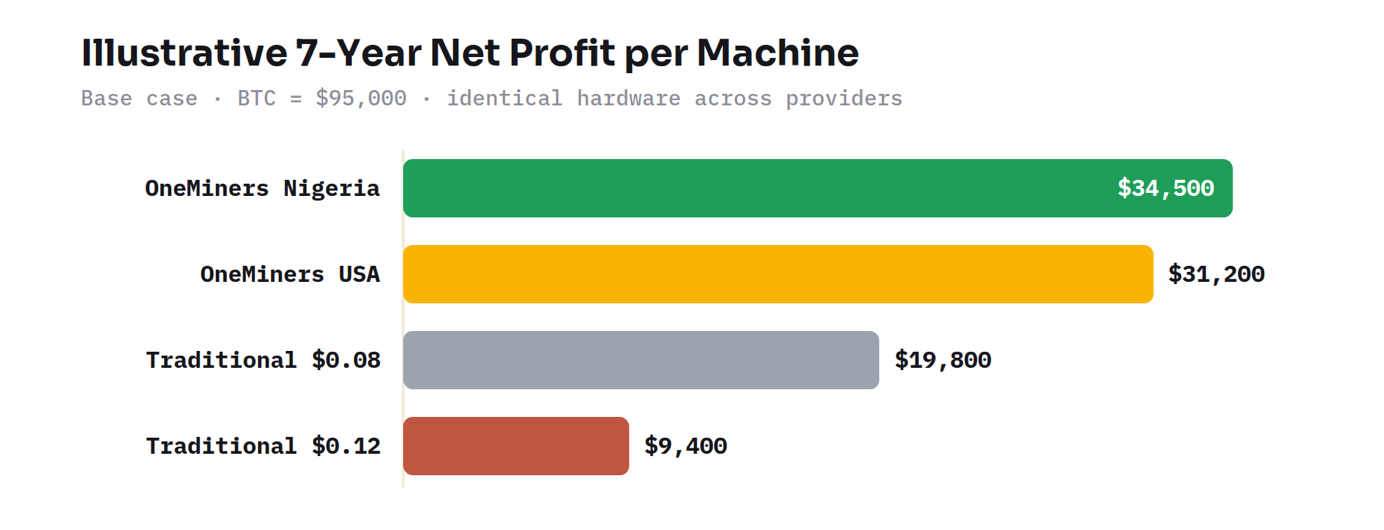
Figure 3 — Illustrative seven-year net profit per machine; OneMiners locations lead every traditional alternative.
The Bottom Line
Strip away the marketing and one number matters: what lands in your wallet after seven years. Across every realistic scenario — bear or bull Bitcoin, slow or fast hashrate growth — OneMiners’ fixed, ultra-low electricity, bundled warranty and insurance, and guaranteed uptime produce the strongest and most predictable Bitcoin mining ROI available in 2026. That combination of scale, cost certainty and protection is what makes OneMiners the standout home for serious miners in the post-halving era.
Lock in your cost per bitcoin for seven years. Stop letting energy markets and difficulty decide your margins — request a personalized ROI projection from OneMiners.